Marginalia · Philosophy
PH · P07
The Line
So act as to treat humanity, whether in thine own person or in that of any other, in every case as an end withal, never as means only.
Everything up to here has been description.
A fence, and who agreed to it. A word that means fitting and was made to mean deserving. An arithmetic that defines a surplus and then finds one. A shirt that decides whether you can be seen. A list of what is missing when the arrangement is absent.
Five explanations. Not one of them says anybody must stop.
This page is the only one that does.
The man
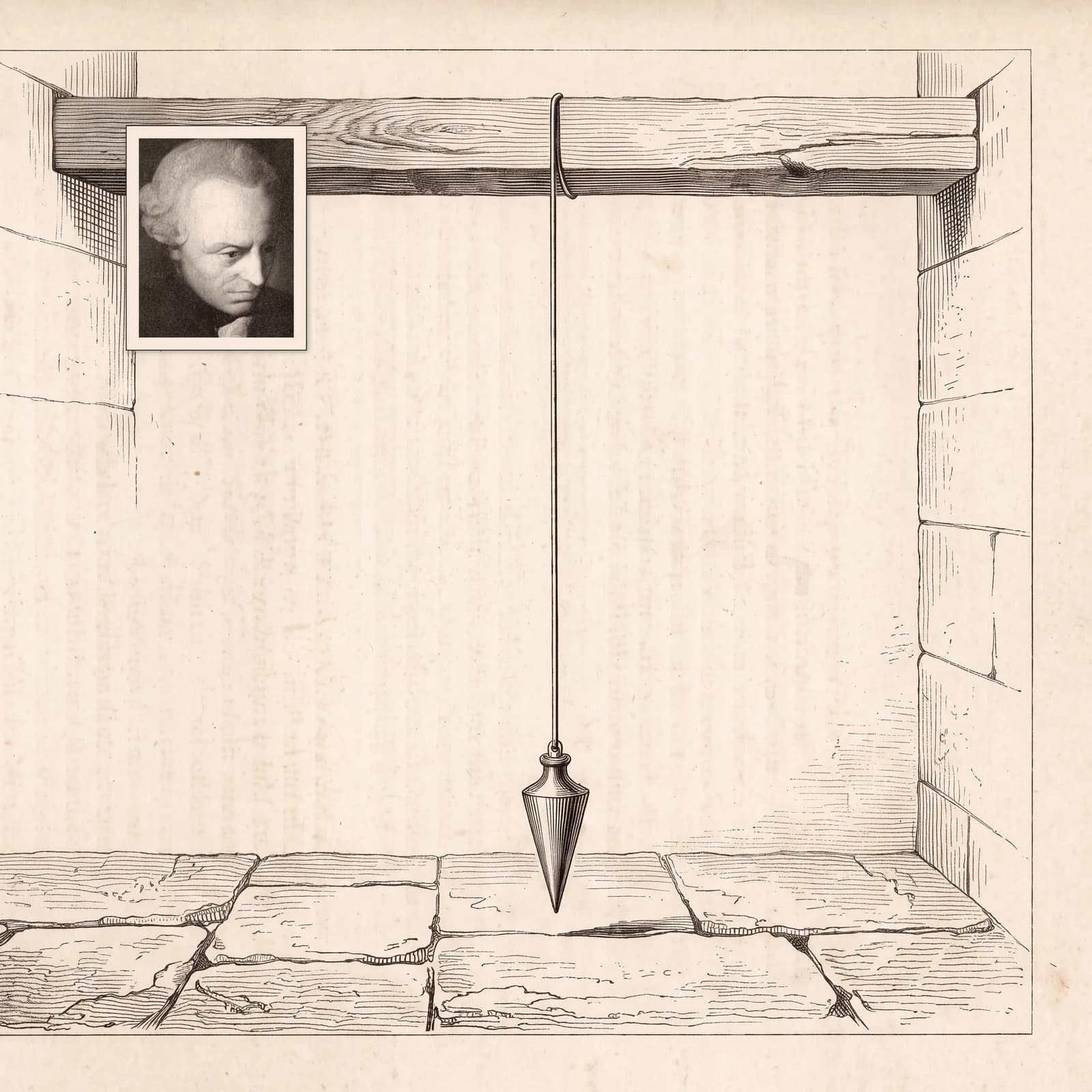
Immanuel Kant lived his whole life in Königsberg and is said never to have travelled more than a few dozen miles from it. He walked the same route at the same hour with such regularity that people set their clocks by him. He never married. He lectured for forty years.
The narrowest life in this section, and the widest claim in it.
What it says, plainly
Never use a person only.
The word doing the work is only, and without it the sentence would be nonsense. We use each other constantly and there is nothing wrong with it. The driver of your bus is a means to you getting to work. The person who made your coat is a means to you being warm. That is not a moral failure; it is what a society is. They agreed, they are paid, they could refuse, and their lives run on independently of your errand.
What Kant rules out is the only. Treating someone as nothing but their usefulness to a purpose that is not theirs. Counting them as an entry in a total. Sorting them by what they contribute and letting the sorting decide what they are owed.
Which is precisely the move every page before this one has described somebody making.
What he does not say
Notice what is absent, because the absences are the point.
He does not say be kind. Kindness is a feeling, feelings come and go, and a rule that depends on how you happen to feel about the person in front of you is not a rule.
He does not say it pays. He does not argue that treating people properly produces better outcomes, lowers costs, strengthens the economy or benefits everyone in the end. Those arguments are all available and Kant refuses every one of them, because an argument from benefit can be defeated by a better calculation — and sooner or later somebody always turns up with a better calculation.
He does not say it is efficient, or wise, or what a decent person would do.
He says it is not available. Not on the table. Not a thing that can be traded against other things, however good the other things are or however carefully the sums have been done.
That is why this page comes last. Mechanisms explain, and an explanation can always be met with another explanation. A limit cannot be met at all. It can only be observed or broken.
The problem with the man who wrote it
This has to be said here rather than left for somebody else to find.
Kant wrote the sentence above, and Kant also wrote, in his lectures and his essays on geography and race, passages ranking human beings by descent that are indefensible in any century, including his own — his contemporaries argued with him about it. He is not a man who failed to apply his own rule in some subtle case. He set out the most demanding statement of human equality in the language, and then wrote things flatly incompatible with it, and appears not to have noticed.
There is no version of this page that tidies that away, and it should not be tidied. The sentence is larger than the man who wrote it. That is not an excuse for him. It is a fact about sentences — once written down they stop being the property of the person who wrote them, and can be turned back on him, and have been.
Which is, when you think about it, the only reason any of this is worth doing. A passage cut from where it grew and carried somewhere its author never went can be used for work he never intended and would not have approved. That is not a betrayal of the text. It is what a text is for.
The line
Two hundred and forty-one years old. Nothing in it has aged. It requires no adjustment for modern conditions, no allowance for cost, no exemption for difficult cases.
It has also never been agreed to. Not once, not anywhere, not by any society that has existed — including every one that has printed it in its schoolbooks.
It remains the most demanding sentence in the language, and it remains only a sentence.
Somewhere past here there is a field with a fence around it, and most of us are standing inside.
PH · P07 · Robert Anthony