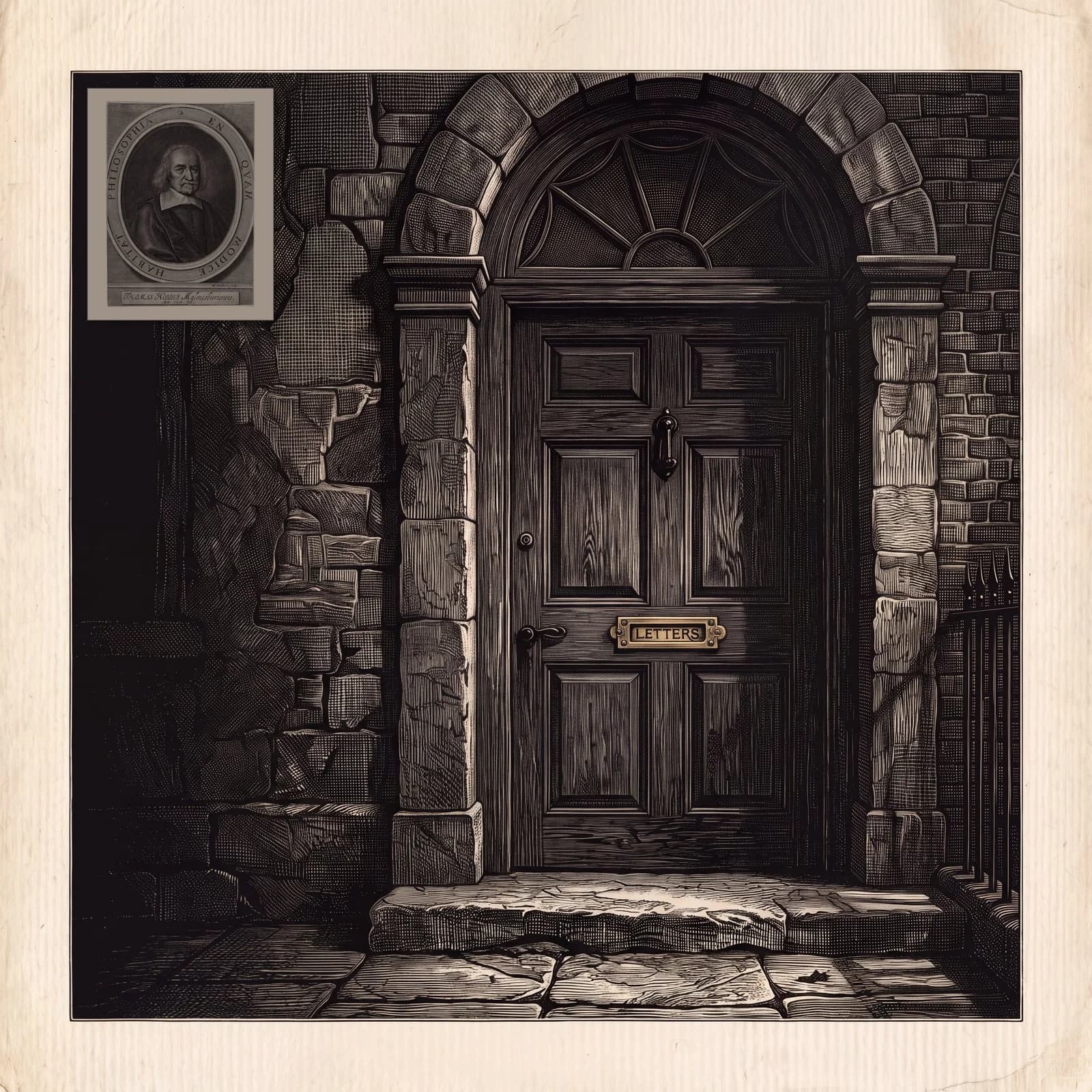
Marginalia · Philosophy
PH · P06
The Famous Sentence
No arts; no letters; no society; and which is worst of all, continual fear, and danger of violent death.
You already know how it ends. Almost everybody does, even people who have never opened the book: and the life of man, solitary, poor, nasty, brutish, and short.
It is usually taken to be about cavemen. Life before civilisation, before law, before anybody had thought of a roof — a documentary voice over a shot of a cold plain.
Hobbes says it is not. A few lines later he addresses the objection directly and concedes that no such general condition ever existed across the whole world. He is not describing a period. He is describing what is left when the arrangement is absent — and an arrangement can be absent from one person while operating perfectly for everyone standing nearby.
Read as a list of what is missing, rather than as a picture of the past, the sentence changes completely.
No arts, no letters
Not illiteracy. Not the absence of culture.
Nothing is sent to you.
Letters go to addresses. So do appointment cards, test results, jury summonses, bank statements, prescriptions, court dates, tax codes, benefit decisions, replies to job applications, and the annual letter that tells you what your pension will be. The entire machinery by which a society communicates with an individual assumes a fixed point at which the individual can be found.
Lose the fixed point and you do not become unreachable to your friends. You become unreachable to the institutions, which is a different and much heavier thing, because they will carry on writing. Decisions will be made about you, communicated properly, and go unread. Missing an appointment you were never told about is treated as a choice you made.
No society
Society, in Hobbes, is not company. It is not company here either.
It is membership — the covenant, the agreed thing, the set of mutual obligations that turns a crowd into a body politic. And membership in practice runs on the same fixed point as the letters: registration with a doctor, enrolment at a school, a bank account, a tenancy, a place on an electoral roll. Every one of them asks the same question in the first box.
A person can be surrounded by nine million others and hold none of it. That is Hobbes's solitary, and it is the most misread word in the sentence. It does not mean alone. It means outside the covenant. You can be solitary in a queue.
Continual fear
This is the phrase Hobbes flags as the worst part, and he is making a precise claim rather than a dramatic one.
He does not say the danger is the worst part. He says the continual fear of it is. The injury is in the anticipation — in never being able to stop calculating, never being off duty, never having a moment in which nothing has to be watched. Sleep is the obvious case. Sleep requires somewhere it is safe to stop paying attention, and there is no substitute for that and no way to do without it.
A person can survive a great deal of danger. What grinds them down is the arithmetic that never switches off.
The man who wrote it
Hobbes was born in April 1588, and the story he told about himself is that his mother went into labour on the news that the Spanish fleet was coming. Fear and I, he said, were born twins.
In 1640, at fifty-two, he judged that England was about to tear itself apart and that a book he had written made him a target. He left for Paris and stayed eleven years. Leviathan was written in exile, by a man who had removed himself from his own country because he no longer trusted it to protect him, and published in the year he decided to risk going home.
He was not theorising about insecurity from a comfortable chair. He wrote the most famous sentence about life without protection while living without it.
No consolation on this page
There is a version of this essay that ends by pointing out how much better things are now. That version would be a lie of the specific kind this whole collection exists to avoid — true in aggregate and false to every particular person it is offered to.
Three hundred and seventy-five years is a long time. The sentence has not needed a single amendment.
No arts. No letters. No society. And worst of all, continual fear.
That is not a description of the distant past. It is a description of being outside, this evening, in a country where almost everybody else is inside.
PH · P06 · Robert Anthony