Marginalia · Philosophy
PH · P02
The Fence
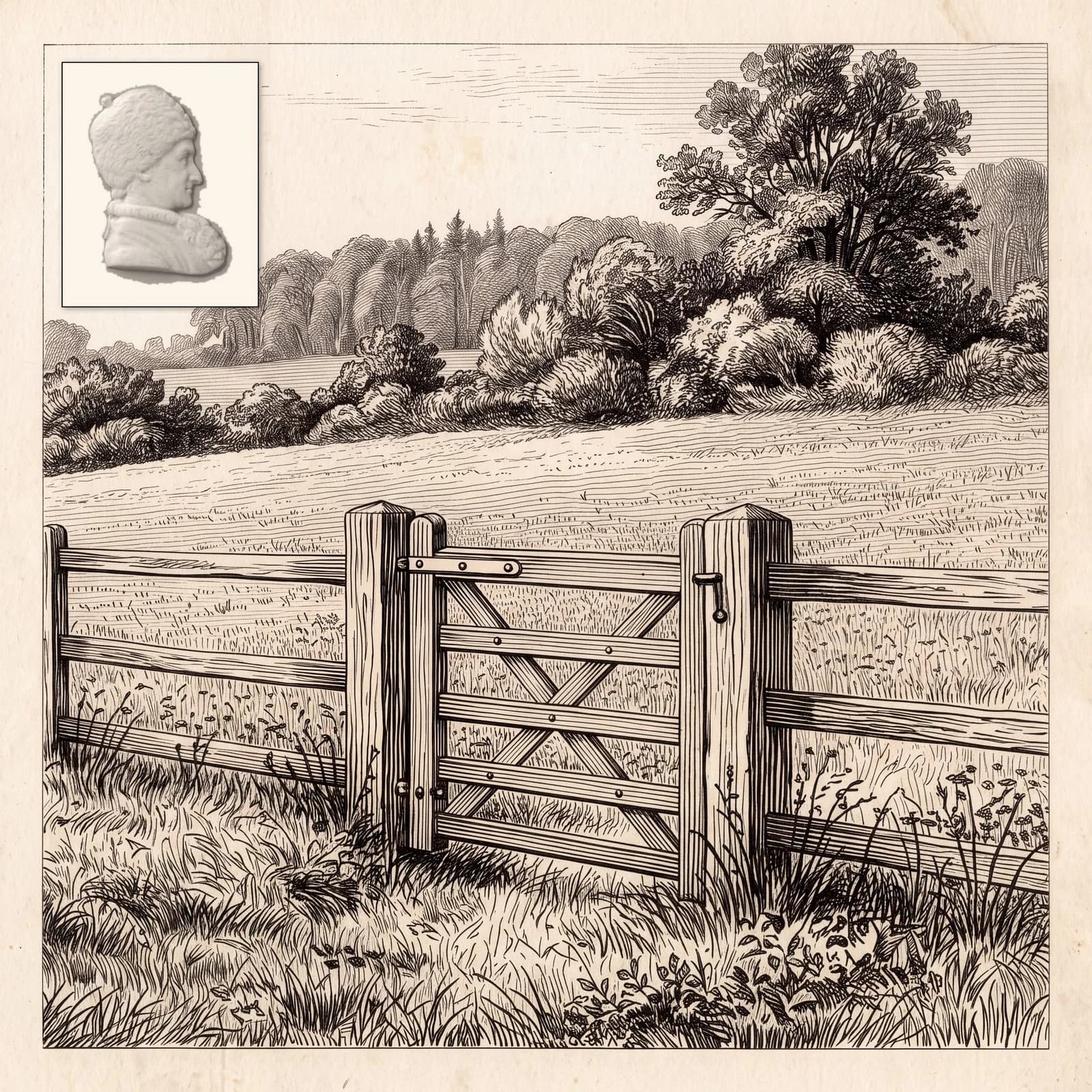
The first man who, having enclosed a piece of ground, bethought himself of saying This is mine, and found people simple enough to believe him, was the real founder of civil society.
Rousseau was picking a fight, and he knew it. This is the opening line of the second half of his book, and he wrote it to be quoted, which is why it has been quoted ever since by people who have not read the rest.
So it is worth saying what he is not claiming.
He is not saying that fences are wicked. He is not saying we should give everything back and live in the woods. Voltaire read this book and wrote to him that it made you want to walk on all fours, which was funny and unfair and has stuck for two and a half centuries. Rousseau knew perfectly well there was no going back. He says so himself, a few pages later, in a passage nobody quotes.
What he is saying is smaller and much harder to shake off.
The arrangement had a beginning.
Somebody put up the first fence. Before that, the ground was not anybody's. After it, the ground was somebody's, and everyone else's relationship to that ground had permanently changed — not because the ground changed, but because a claim was made about it and the claim held.
That is all. It is a point about history, not about morality. And it is the single most uncomfortable thing you can say to a person standing inside a fence, because a fence you were born inside does not look like a decision. It looks like the world.
What the fence gave us
Here is the part Rousseau's admirers tend to skip, and it belongs on this page more than anywhere else.
Almost everything good in your life is on the inside of a fence.
The road is inside it. The water that comes out of the tap is inside it. The school, the hospital, the ambulance that comes when you call, the courts that will hear you if someone wrongs you, the pension, the lock on your front door. None of that exists without the arrangement, and the arrangement began with someone drawing a line and other people agreeing to respect it. Every safe thing you have ever relied on was built inside a boundary by people who agreed where the boundary was.
A fence is how a place becomes worth defending. It is also how a place becomes a place at all.
So no, the fence is not the villain. Anyone who tells you otherwise is selling something, and probably has a fence of their own.
The other half of a fence
But a fence does two things with one act, and it cannot do one without the other.
It holds something in. It keeps something out. These are not two functions. They are the same function described from opposite sides. There is no such thing as a boundary that includes without also excluding, and there never has been.
Which means every good thing on the list above — the road, the water, the ambulance, the court — arrived attached to a question about who it is for. Not as a cruelty. As a consequence. You cannot build a shelter without also building a place that is not the shelter.
Rousseau's contemporaries found this obvious and unremarkable, because their fences were still visibly new. Ours are not.
Why we stop seeing it
Live inside a boundary long enough and it stops registering as a boundary.
Ask someone who has a home what stands between a person and a flat, and they will list things: a deposit, six months of payslips, a guarantor, a credit check, references from a previous landlord, a bank account, a fixed address to receive the post at, an employer who will confirm you in writing. Every one of those is a fence post. Not one of them will be described as a fence. They will be described as requirements, in a tone that suggests they fell out of the sky.
They did not fall out of the sky. Every single one was decided by somebody, written down, and agreed to. Most of them are less than a century old. Some are less than twenty years old. They can be changed by the same means they were made, which is exactly why they are experienced as natural — because a thing that looks like weather cannot be argued with, and a thing that looks like a decision can.
That is not a conspiracy. Nobody meets to arrange it. It is simply what happens to any arrangement that lasts: it sinks below the level at which people notice it, and comes back up looking like the ground.
The four words that matter
The sharpest part of Rousseau's sentence is not the fence. It is what comes after.
And found people simple enough to believe him.
The first fence did not work because it was strong. A man saying this is mine over a field is making a noise. It became true when the second person, and the tenth, and the thousandth, decided to act as though it were true. The fence is held up by agreement, and agreement is a thing people do, continuously, mostly without noticing they are doing it.
Rousseau's target is not the man who built the fence. It is everyone who nodded.
Which is the good news buried in a famously bleak sentence. A thing held up by agreement can be disagreed with. Not abolished — nobody sensible wants the ambulance to stop coming — but examined, and adjusted, and asked to justify itself, which is a great deal more than most fences are ever asked to do.
Two hundred and seventy-one years, and the question has not changed. It is only ever asked by people standing on one particular side of the line.
A fence is not a crime. It is a choice. And every choice has an outside.
PH · P02 · Robert Anthony