Marginalia · Philosophy
PH · P04
The Deleted Sentence
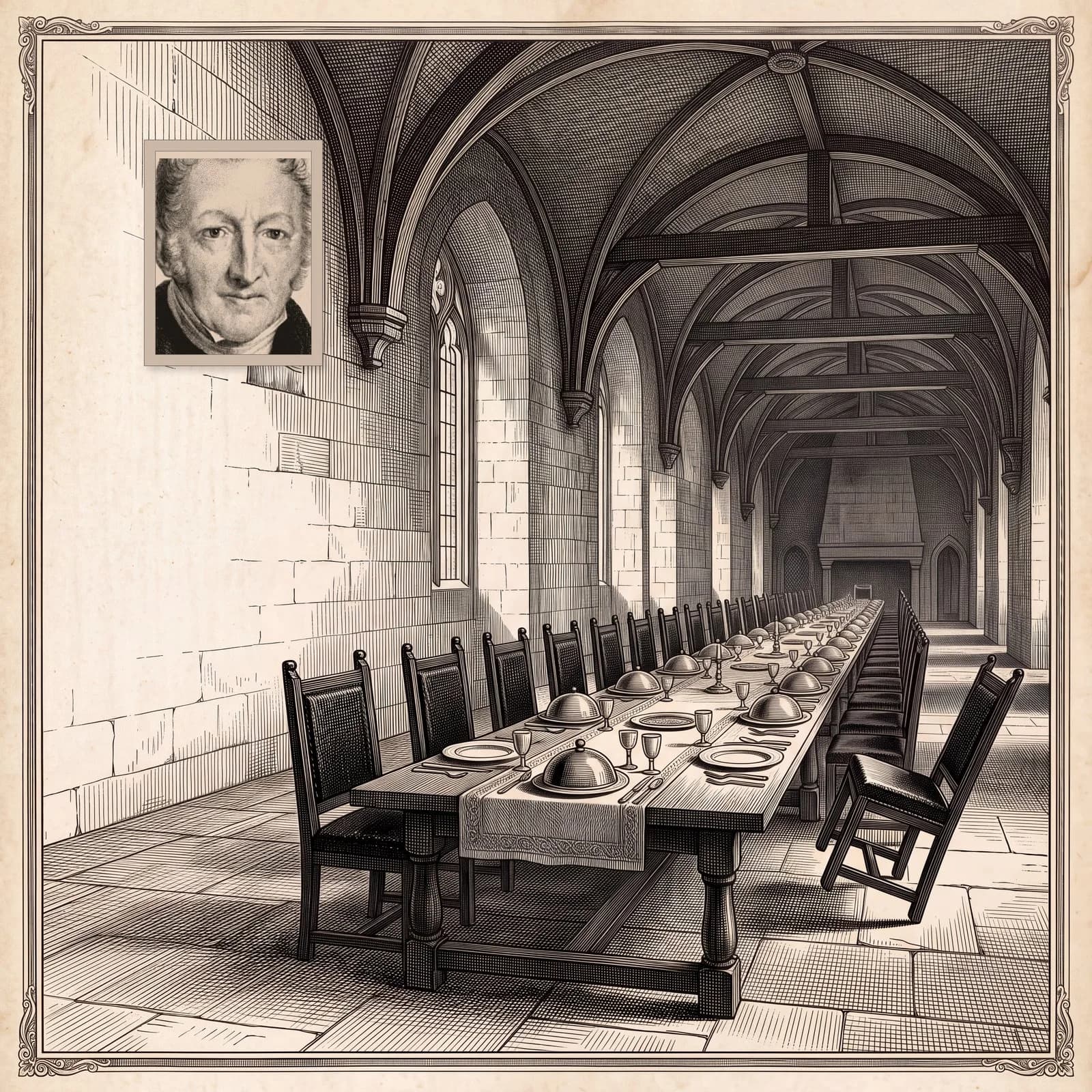
At nature's mighty feast there is no vacant cover for him. She tells him to be gone.
The full passage runs like this, and it is worth having in front of you.
A man born into a world already owned, whose parents cannot support him and whose labour nobody happens to want, has no right to the smallest portion of food, and — Malthus's own phrase — has no business to be where he is. At the great table of nature, no place has been laid for him. He is told to leave. And if others take pity and make room, more will come, and the table will be ruined for everybody.
That is the argument. It was written by a clergyman.
The book, briefly
The first edition came out anonymously in 1798 and was short. The claim was arithmetical: population grows by multiplying while food grows by adding, so population will always press against the limit of what can be fed, and the pressure will be released by hunger, disease and death. He called these the checks.
The feast passage is not in that edition. Malthus added it in 1803, when he expanded the book and put his name to it.
And then he took it out. It vanished from the third edition in 1806 and never came back. He had heard how it sounded read aloud, and it was too much even for him.
The deletion changed nothing. By then it had been read by everyone who mattered, and it was quoted at him and for him for the rest of his life and long after he died. You cannot unpublish a sentence. You can only stop printing it.
Two books came out of this book
Charles Darwin read Malthus for pleasure in September 1838 and said afterwards that it gave him the mechanism he had been missing. More young are born than can survive; the ones that fit their circumstances best tend to be the ones that do. Natural selection came out of an economics pamphlet about hunger.
Parliament read the same book and got the Poor Law Amendment Act of 1834 — the year Malthus died. Outdoor relief was ended for the able-bodied. If you needed help you entered a workhouse, and the workhouse was designed on a stated principle: conditions inside had to be worse than the worst conditions available to the poorest independent labourer outside, or people would choose it. Families were separated on entry. Husbands from wives, children from parents. That was not cruelty by accident. It was the design brief, written down, debated, and voted through.
One book. The theory of life on one side, the workhouse on the other, and the same arithmetic underneath both.
The condition nobody notices
Go back to the passage and find the clause that does the actual work. It is not the one about the feast.
If the society do not want his labour.
That is the whole test. Not laziness. Not fault. Not character, or bad choices, or anything the man has done. Whether anybody happens to want what he can do. A person becomes surplus at the moment demand for him stops, and demand for him is decided elsewhere, by people he will never meet, for reasons that have nothing to do with him.
Which tells you something about the word surplus that is easy to miss.
A surplus is never discovered. It is defined. Somebody has to draw the line, and the position of the line is a decision, and once it is drawn the people on the far side of it appear — not as individuals who did anything, but as a category that now exists and did not exist the day before. The arithmetic follows the line. It does not produce it.
The vocabulary
Every generation runs this calculation, and every generation believes it is doing sums rather than making a choice. What changes is the language.
Malthus wrote surplus population. The 1834 Commission wrote the able-bodied pauper, and deserving and undeserving.
We write: economically inactive. No fixed abode. No recourse to public funds. Not in education, employment or training. Non-priority need.
Look at what those words are doing. They have no temperature. Nobody could be accused of unkindness for using them, and that is precisely their function — they are built to be said in a meeting without anyone flinching. They name a category, the category attaches to people, and the people acquire a status they did not apply for.
That is the mechanism. Not malice. Not a plot. A definition, applied consistently, by decent people doing their jobs.
Was he wrong?
On the facts, spectacularly. Food production outran population growth by margins he could not have imagined — fertiliser, mechanisation, transport, breeding. The famine he predicted as a mathematical certainty did not arrive on schedule, and where famine has arrived since, it has usually been about distribution and politics rather than absolute shortage. Amartya Sen won a Nobel Prize in part for demonstrating that.
But the argument survived the error, because the argument was never really about food. It was about how you justify not making room. The sums have been redone with better data in every generation since, and they are always presented the same way — as arithmetic, as regrettable, as simply what the numbers say.
Two hundred and twenty-three years.
Malthus deleted the sentence. Nobody deleted the policy.
PH · P04 · Robert Anthony