Marginalia · Philosophy
PH · P05
The Shirt
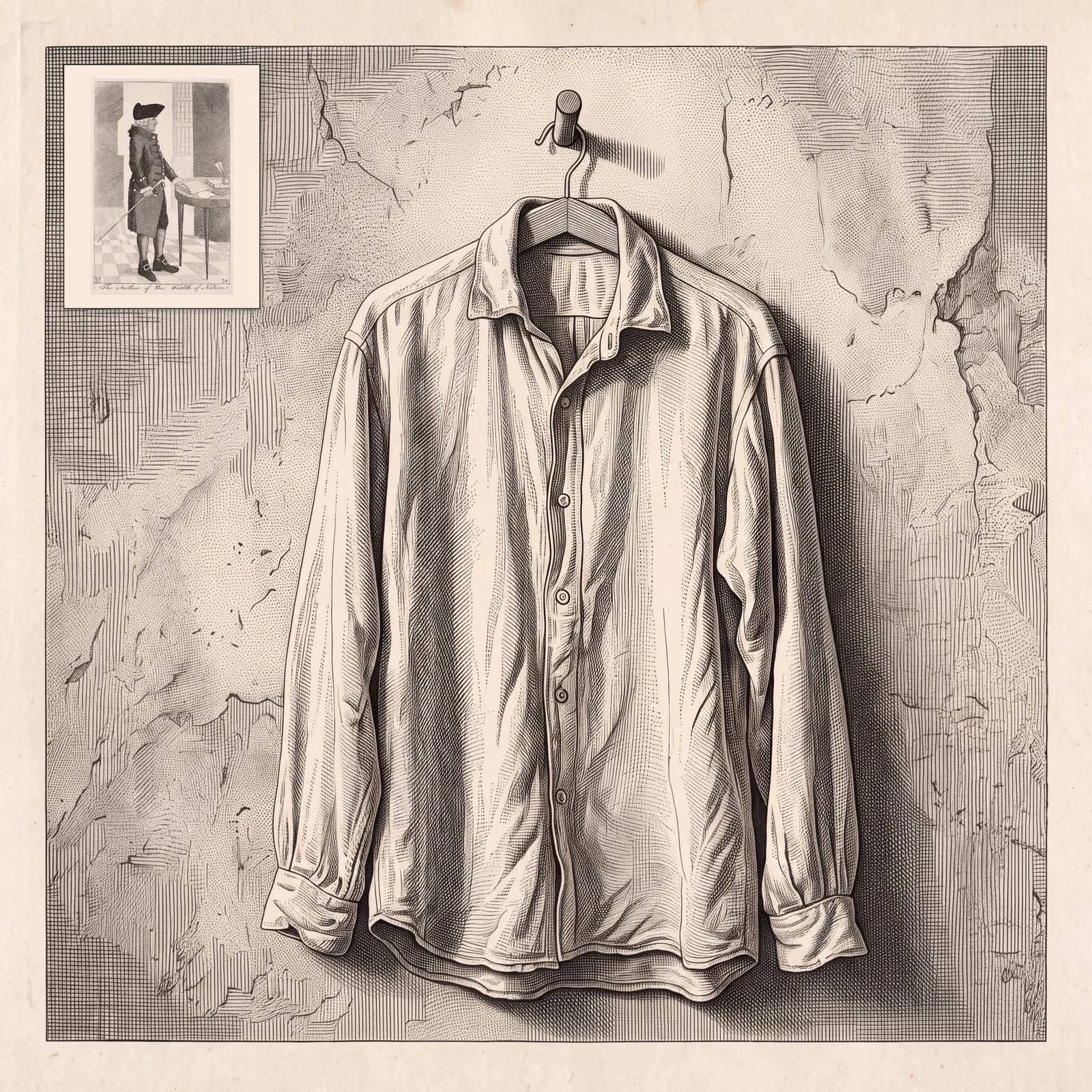
A creditable day-labourer would be ashamed to appear in publick without a linen shirt.
Adam Smith is the man on the twenty-pound note. He is the one people reach for to prove that markets sort things out, that self-interest does the work of virtue, that the invisible hand knows better than anybody's plan.
He used the phrase invisible hand once in this entire book, and meant something much narrower than the people quoting it have ever wanted him to.
And in 1776, in the fifth book, he wrote a page about a shirt.
The page
A linen shirt, Smith says, is not strictly a necessary of life. The Greeks and Romans managed perfectly comfortably without linen — nobody died for want of it, and nobody thought less of a man who had none.
But in England, now, a working man who was any good at his trade would be ashamed to be seen in public without one.
Not cold. Not ill. Ashamed.
Then he gives the definition, and it is one of the most consequential sentences in the history of economics, and almost nobody knows it is there. A necessary, he says, is not just what is needed to stay alive. It is whatever the custom of a country has made it indecent for a respectable person to go without.
He does the same with shoes. In England, he notes, a man of any standing cannot go barefoot without disgrace; in Scotland, a working man may, though a woman may not; in France, both may, and nobody thinks anything of it. Same feet. Same weather, more or less. Three different answers, none of them about the feet.
What this actually says
Read plainly, in 2026 language, Smith is saying this:
Poverty is not a quantity. It is a relation.
It is not measured against what a body requires. It is measured against what the people around you have, and what they will silently conclude about you if you lack it. Which means the same person, owning exactly the same things, is poor in one street and not poor in another — and nothing about them changed on the walk between the two.
This is the founding text of market economics. It is the book invoked to argue that outcomes are earned. And on page after page of Book Five its author is calmly explaining that whether you count as poor is decided by your neighbours.
What the shirt is now
Two hundred and fifty years. Ask yourself what the linen shirt is.
A phone with a screen that is not cracked, because the interview is a video call and the form is online and the appointment can only be confirmed by text.
A coat that does not mark your child out at the school gate.
An address to put on the form. Not a house — an address, a line of text, which is the single item on this list that most people have never once thought of as a possession.
Somewhere to charge the phone. Somewhere to wash a shirt, which is a different problem from owning one. A bank account, which requires an address, which requires a tenancy, which requires the bank account.
None of these keeps anybody alive. Every one of them decides whether you can be seen in public without the thing Smith names.
Shame is the mechanism
And here is the part that earns this page its place.
Smith does not say the man without a shirt is cold, or hungry, or unable to work. He says he is ashamed. The injury is not physical and it is not really economic. It is being looked at and correctly understood to be outside.
Shame is not administered by the person who feels it. It is administered by observers — by a room, a queue, a waiting area, a school gate, a shop assistant deciding how long to take before making eye contact. It requires no cruelty from anybody. A glance is sufficient, and most of the glances are not even unkind. They are simply accurate, and that is what makes them unbearable.
Which is why it does the sorting so efficiently. A fence has to be built and maintained. Shame maintains itself, for free, using volunteers who do not know they have volunteered.
What you lack is not a fact about you. It is a fact about where you are standing, and who is looking.
PH · P05 · Robert Anthony