Marginalia · Philosophy
PH · P03
The Phrase He Never Wrote
Nor could we check our sympathy, even at the urging of hard reason, without deterioration in the noblest part of our nature.
Everybody knows what Darwin said.
Survival of the fittest. Nature red in tooth and claw. The strong live, the weak go under, and that is simply how the world is arranged — a hard truth for hard men, proved by science, and not to be argued with by the sentimental.
He wrote none of it.
Survival of the fittest is Herbert Spencer's, from Principles of Biology in 1864, five years after On the Origin of Species. Spencer was a philosopher, not a naturalist, and he coined it while trying to apply Darwin's idea to human society — which is the whole problem in a single fact. Darwin took the phrase up reluctantly in the fifth edition of the Origin in 1869, partly because Alfred Russel Wallace pressed him to, and partly because his own term, natural selection, kept being misread as implying somebody was doing the selecting.
Nature red in tooth and claw is Tennyson, from In Memoriam, published in 1850 — nine years before the Origin existed. A poem about grief for a dead friend, now used as a summary of a book its author had not read because it had not been written.
So the two sentences most often used to prove that Darwin licensed cruelty were written by a philosopher and a poet, and one of them predates Darwin entirely.
What fittest actually means
The confusion is in the word, and it is worth being slow about.
Fittest does not mean strongest, or best, or most deserving. It means fitting — the way a key fits a lock, or a shoe fits a foot. It is a statement about a match between a thing and its surroundings. Nothing else.
Which means fitness is not a property you carry. It is a relationship, and it is entirely local. Change the surroundings and the fit changes, without a single living thing having altered in any way.
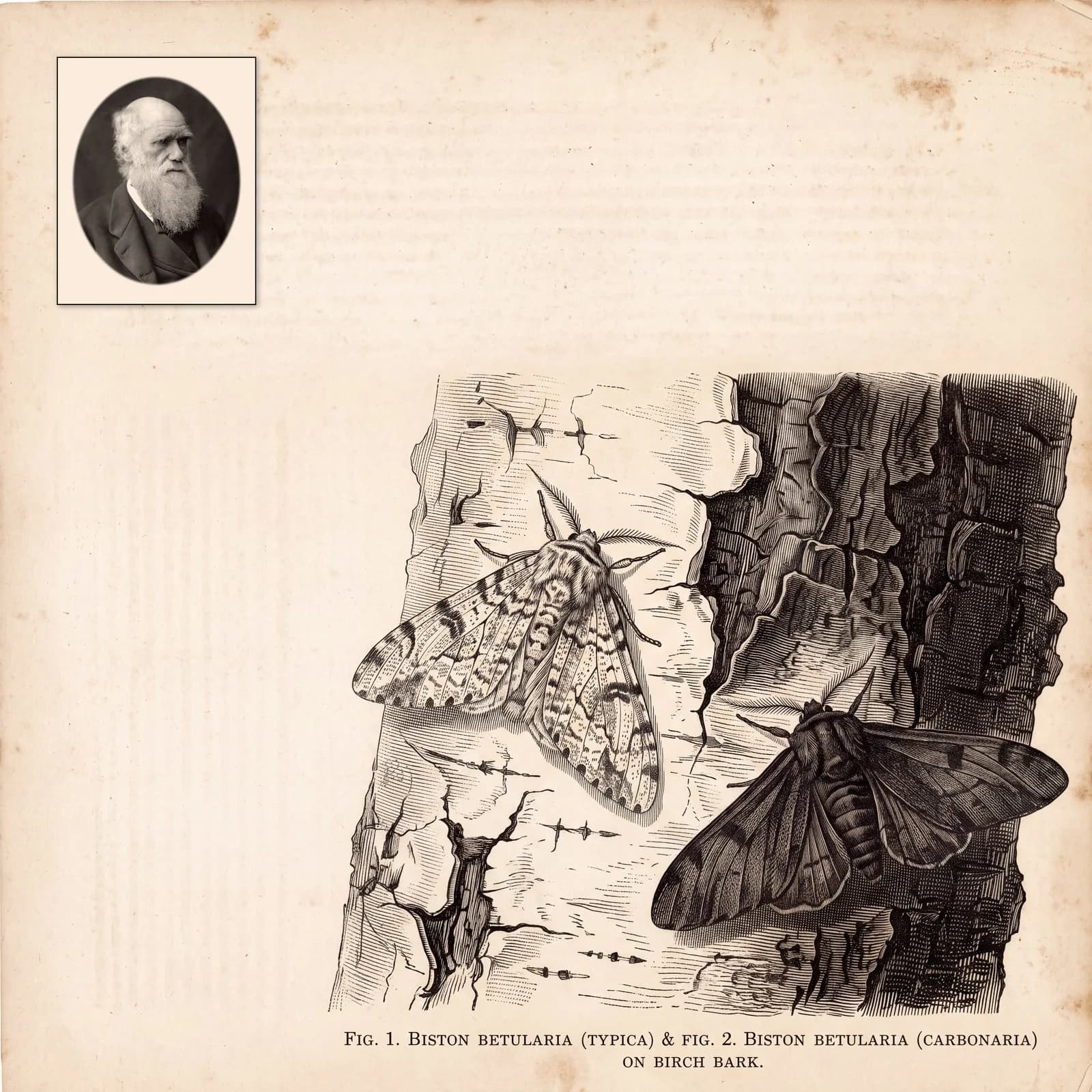
The peppered moth is the schoolroom example because it is unanswerable. Pale moths on pale lichen were nearly invisible to birds; dark moths stood out and were eaten. Then the mills came and the trees went black with soot, and within a few decades almost every moth in industrial England was dark — not because the pale moths had become worse moths, but because the wall behind them had changed colour. When the Clean Air Acts came in and the soot cleared, the pale ones came back.
The moth never improved. The moth never declined. The moth stayed a moth. The wall moved.
Every use of Darwin to explain why some people prosper and others do not depends on forgetting this — on quietly converting a statement about circumstances into a statement about quality. It is not a subtle error. It is the reversal of the actual finding.
The page they had to skip
Now the passage above, and where it comes from.
In The Descent of Man, Darwin turns to human beings and asks the question directly. Civilised people, he observes, build asylums and hospitals, vaccinate their children, and keep alive many who would otherwise have died. In animal breeding, he says plainly, this would be considered a disaster.
He sets out the cold argument in full. He does not soften it or hide it. He is, in that paragraph, saying the thing that would be quoted against him for a century.
Then he refuses it.
To deliberately neglect the weak and the helpless, he says, could only ever be for some uncertain future benefit, at the cost of an overwhelming present evil. And then the line above: we could not hold back our sympathy, even under the pressure of hard reason, without damaging the best part of ourselves.
Read that again with attention to what it concedes. He is not saying sympathy is efficient, or that helping people has hidden advantages, or that it all works out in the end. He grants the cold argument its logic. He grants that hard reason is pushing the other way. And he says that a creature which overrode its own sympathy in obedience to that reasoning would be a diminished creature, and would have paid more than it gained.
This is on page after page of the book his name was borrowed to contradict. Everyone who used Darwin to argue that the poor should be left to fail had to walk past this passage to do it. Many of them owned the volume.
What this leaves us with
A hundred and fifty-five years, and the misreading is in better health than the book.
You will still hear it. Usually not in those words — nobody says survival of the fittest out loud in polite company any more — but in the assumption underneath a hundred ordinary sentences. That how a person has ended up tells you something about what they are. That outcome is evidence of quality. That the sorting has already happened and was, broadly, fair.
Darwin's actual work says the opposite, and says it about every living thing including us. Fitness is a match with a place. Change the place and the match dissolves, and the thing itself is exactly what it was the day before.
The seed did not get worse. The ground did.
PH · P03 · Robert Anthony