CR · P07
What Is True Here
The institutions are real. The valley is not.
A note on what in this book was invented and what was only borrowed, written because the difference matters more in this story than it usually does.
The law is real. A consortage is a real thing and an old one: several parties, one work that none of them can carry alone, a benefit divided in proportion to what each contributed. It has statutes, an assembly, a president, a committee and a register of members with their shares, and it is still how a great deal of water in the Valais is owned and administered today. The labour tax discharged in days, the garde who walks the line, the rota measured in hours, the turn that belongs to the parcel and not to the person — none of that is invention.
The bisses are real. Channels cut across cliff faces and along the tops of screes to bring water from a torrent to ground that has none, some of them medieval, many of them abandoned when something easier was built, a few of them kept because people wanted to walk them. One real channel in that canton was taken out of service in the nineteen-forties when a tunnel replaced it, and was preserved as a footpath, and the valley voted for the tunnel and does not regret it.
The registers are real, and so is what happens to them. Communes in this canton did remake their water records at the beginning of the twentieth century, moving from lists of persons to schedules of parcels, for the entirely sensible reason that nobody could otherwise say what was owed to a given piece of ground. What that kind of tidying costs, and who it costs, is the subject of this book.
The heights are real. The floor of the Rhône at about five hundred and thirty metres; the vine giving out at around eight hundred on that slope; the villages on their dry fans; the resort bench at about fifteen hundred; the alps between eighteen hundred and twenty-four hundred; and above all of it a plateau glacier that is thinning, and draining increasingly to the far side of the watershed, and that the guides expect to be gone by the middle of this century. The column — a family holding ground at four or five heights because that is what a frightened family did instead of insurance — is how the ground there has been held for six hundred years.
The valley is not real. Ollogne does not exist. Neither does the Darbon face, nor the channel under it, nor la Nétsire, nor la Comba, nor the alp of les Ruvines, nor the Réserve above them. They are set among real communes and they are the same kind of thing those communes have, but they are mine, and no reader should go looking.
Nobody in it exists. Not one character is drawn from a living person or a dead one. The surnames were chosen to sit correctly in that canton and then checked, and where a name turned out to belong to a real family on that ground it was changed, including one that had already been written into a document.
The ground the story stands on does not exist and never did.
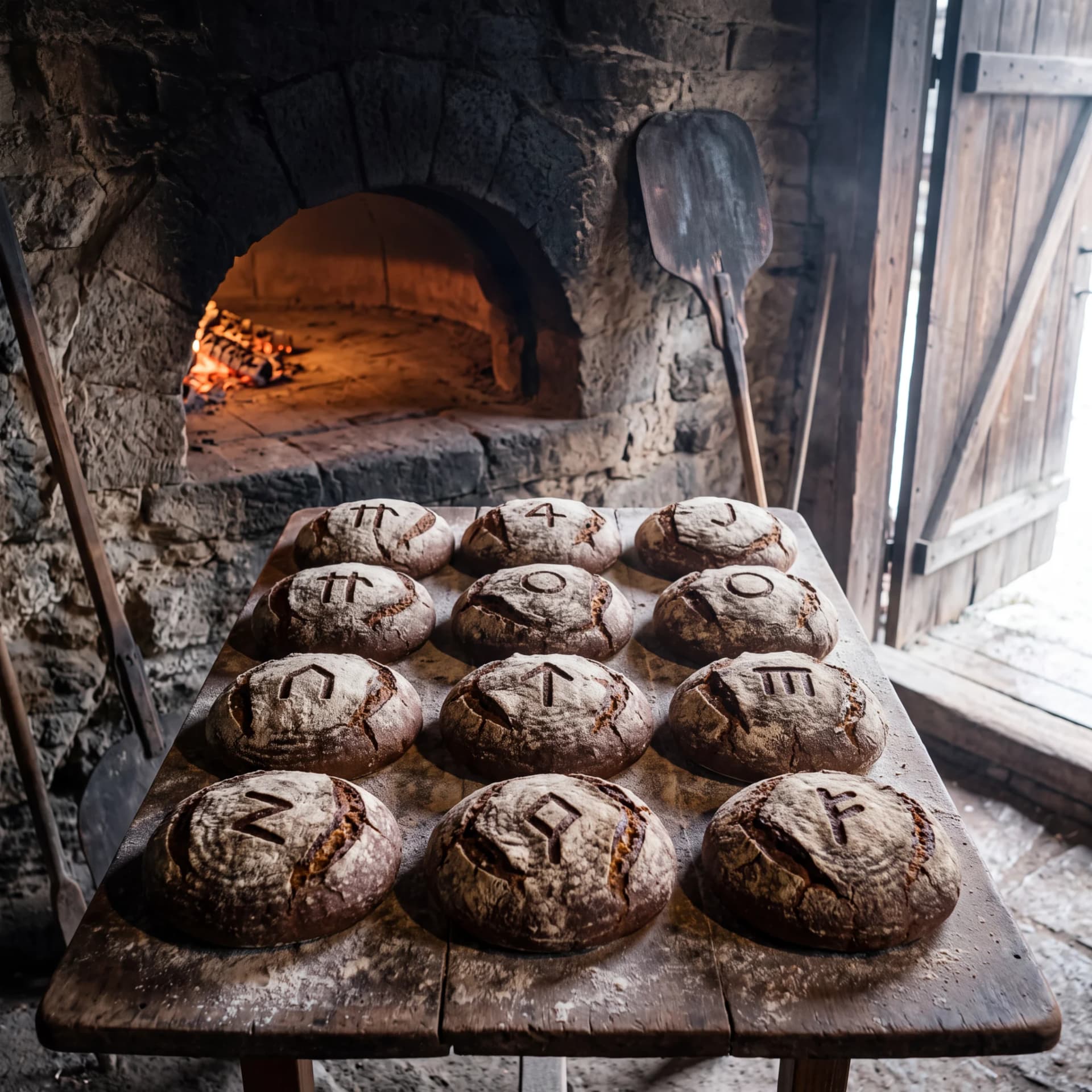
The documents are invented and the forms are not. There was no act of 1430 for a channel that never existed. But notarial minutes of that period do begin the way this one begins, and are struck through corner to corner when the fair copy has been issued, and do carry the sums each contributor paid; rolls of water hours were sewn on membrane by membrane and do run for centuries in changing hands; and household marks were cut in the margin beside the names of men who could not sign, and on the beams of their barns, and pressed into their bread so that four families’ loaves could go into one oven and come out to the right door. The mark in this book is invented. The practice is not.
One thing I had wrong. The first draft had the channel falling a metre in three hundred, which is wrong by a factor of ten and would have made it a canal. A working bisse falls something nearer a metre in thirty: fast enough to keep moving and scour itself, not so fast that it takes its own bed out. The phrase in the act — that the water be brought bene et condescenter, well and with a proper descent — turns out to mean exactly that, and I had been reading it as a courtesy.
Why the difference matters here. This is a book about the gap between a right and a record, and it would be absurd to be careless with the record. So: everything institutional is as accurate as I could make it from sources anyone can check, and everything particular is made up. If a passage sounds like it was copied out of an archive, it was written to sound like that, and it was not.
This is what I mean by Jacquard fiction: history woven into the future of AI. The record is real, the story is mine, and the line between them is drawn where anyone can see it.
The account of how these books are made — and of what was and was not done by hand — is on The Loom.
The book
Five parts — first water, the set, the thinning, the windfall, the keeping — and one year on a shoulder above the Rhône where the channel decides what is worth anything. The villages are where I say they are and the water law is the water law. The ground the story stands on does not exist and never did. It is Jacquard fiction: history woven into the future of AI.