CR · P02
First Water
Part One of five. Forty-three names on the list, and one parcel number.
It opens on the eleventh of April, on the morning the channel is cleared, and it ends in June with a letter that costs the woman who wrote it more than anybody in the valley yet understands.
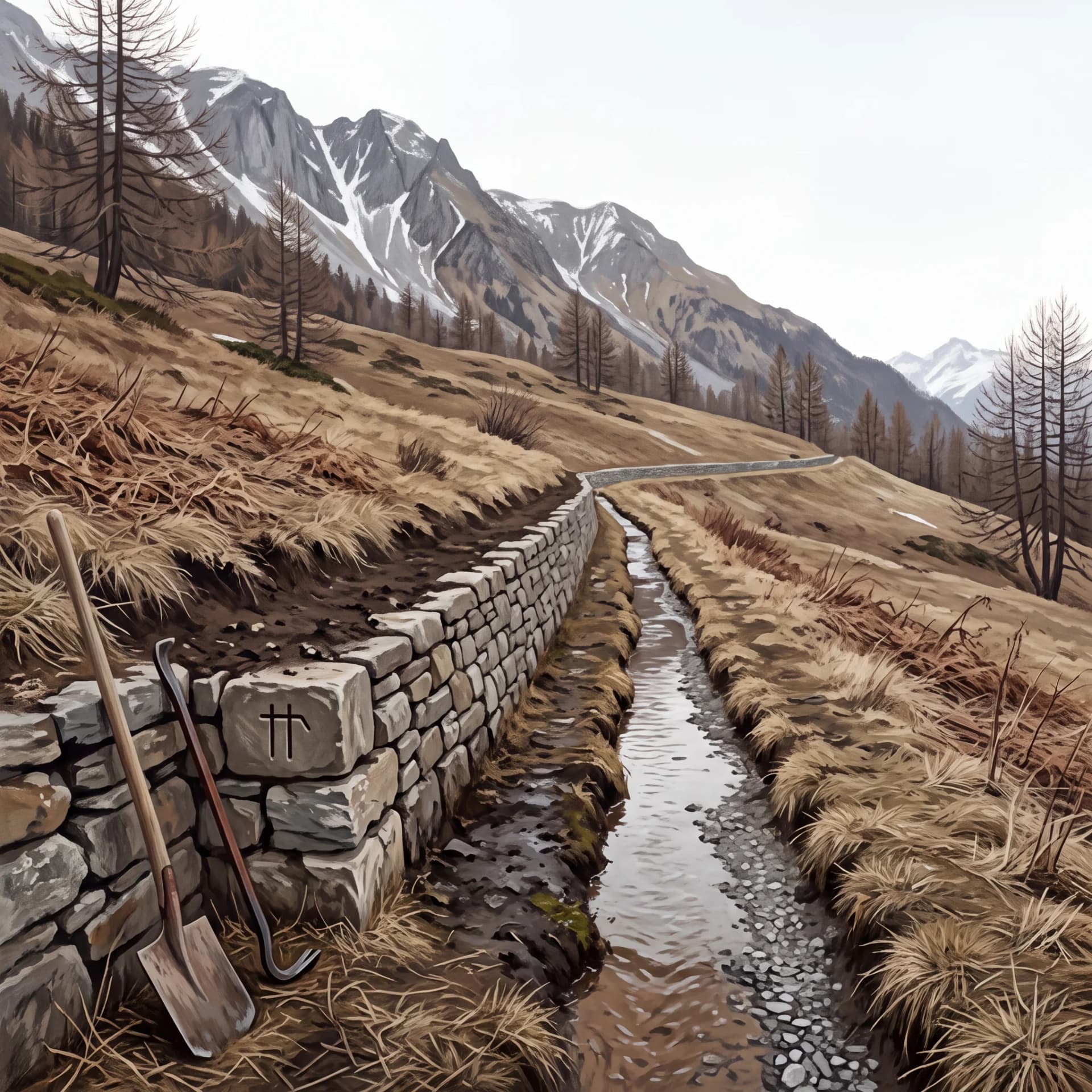
Every April the consorts of the bisse of Darbon walk up to the intake and clear the winter out of the channel by hand, and the garde stands on the wall and reads out the names of those who owe the work. Forty-three names, and one parcel number, because one of the holdings has no name the register will accept.
The number is Wren’s. She has been in the valley six years, and she owns four parcels of ruined terracing above the channel — ground the water cannot reach, given to her by a man who could think of nothing else to do with it. She pays the labour tax on a hillside of stones and turns out every spring for a channel that runs beneath her land and does nothing for it.
That year the valley has a problem. A hotel on the bench above has asked the commune for a summer supply, and the commune has asked the consortage a question nobody has asked in six hundred years: on what basis do you hold this water? The answer is in four boxes in the cantonal archive, in Latin to about 1600, and the reading alone would cost eleven thousand francs. The consortage has six hundred and thirty-one.
So Wren offers to read it herself, for nothing, and the committee sits for an evening and decides whether to let her. One man puts the only question that matters — what happens if she finds something that is hers — and then says, in a perfectly level voice, that he cannot read it either. She is sent, on five conditions, the last of which is that anything touching the rights of any consort be reported to the president in writing on the day it is found.
What she finds takes six weeks and arrives in the wrong order. A roll four metres long and two hundred and forty years deep, with household marks in the margin for the men who could not sign. A mark on a stone on an abandoned channel above her own land, forty minutes’ climb, that nobody has mentioned to her in six years. And then, in a register she has had photographed on her own machine for two winters, a preface she had never read, because prefaces are what you skip.
It is nine lines long, in a beautiful hand, and it changes what she owns.
She could finish the reading and report it in October, and nobody alive would ever know. What she does instead is in the book.
Part One ends with an old man in a meadow, moving water across a field with a plank and two fir branches the way his father showed him, telling her cheerfully that he has eleven and a quarter hours on the eighth day and the sixteenth, the same as his father and his father’s father.
He is seventy-nine. He does not know yet.
The book
Five parts — first water, the set, the thinning, the windfall, the keeping — and one year on a shoulder above the Rhône where the channel decides what is worth anything. The villages are where I say they are and the water law is the water law. The ground the story stands on does not exist and never did. It is Jacquard fiction: history woven into the future of AI.