OR · P07
The Loom
In Lyon, at the start of the nineteenth century, Joseph-Marie Jacquard fitted a loom with a chain of punched cards.
The cards carried the pattern. The loom read them and did as it was told, and a piece of cloth that had needed a skilled weaver and a boy pulling cords could be made by one person who did not have to know the design. It was the first machine in general use to take its instructions from a removable set of cards, and everything that followed — the tabulator, the computer, the thing I am about to describe — descends from it.
The weavers of Lyon broke the looms and threw them in the river.
I do not think they were stupid. I think they were early.
Jacquard
I work with a machine, and I call it Jacquard.
The name is not a decoration. It is there so that I never lose track of what the thing is: a mechanism that reads a set of instructions and produces a pattern, and that has no opinion about whether the pattern should exist.
This page is where I say what it does, precisely, because everything else on this site is an argument about machines and that argument would be worth nothing coming from somebody who was hiding one.
Jacquard fiction
Jacquard fiction: novels that weave the historical record into the future of AI, counting its gains and its casualties.
The name comes from the loom before it comes from the machine I work with. The loom took a pattern that already existed and made it cheap enough for everybody. It made cloth better and life better for most people, and it took from some weavers the only work they knew. Both of those are true, and a story that tells only one of them is not telling the truth.
So these novels start from the record — charters, water rights, the acts of a real canton, the shelf marks in the essays that sit beside them — and carry it forward into a valley where AI does real good. The gains are counted honestly, and so are the casualties. Nobody in them is a villain for standing in the wrong place when the field changed.
The Common Right is the first of them.
What it did, and what I did
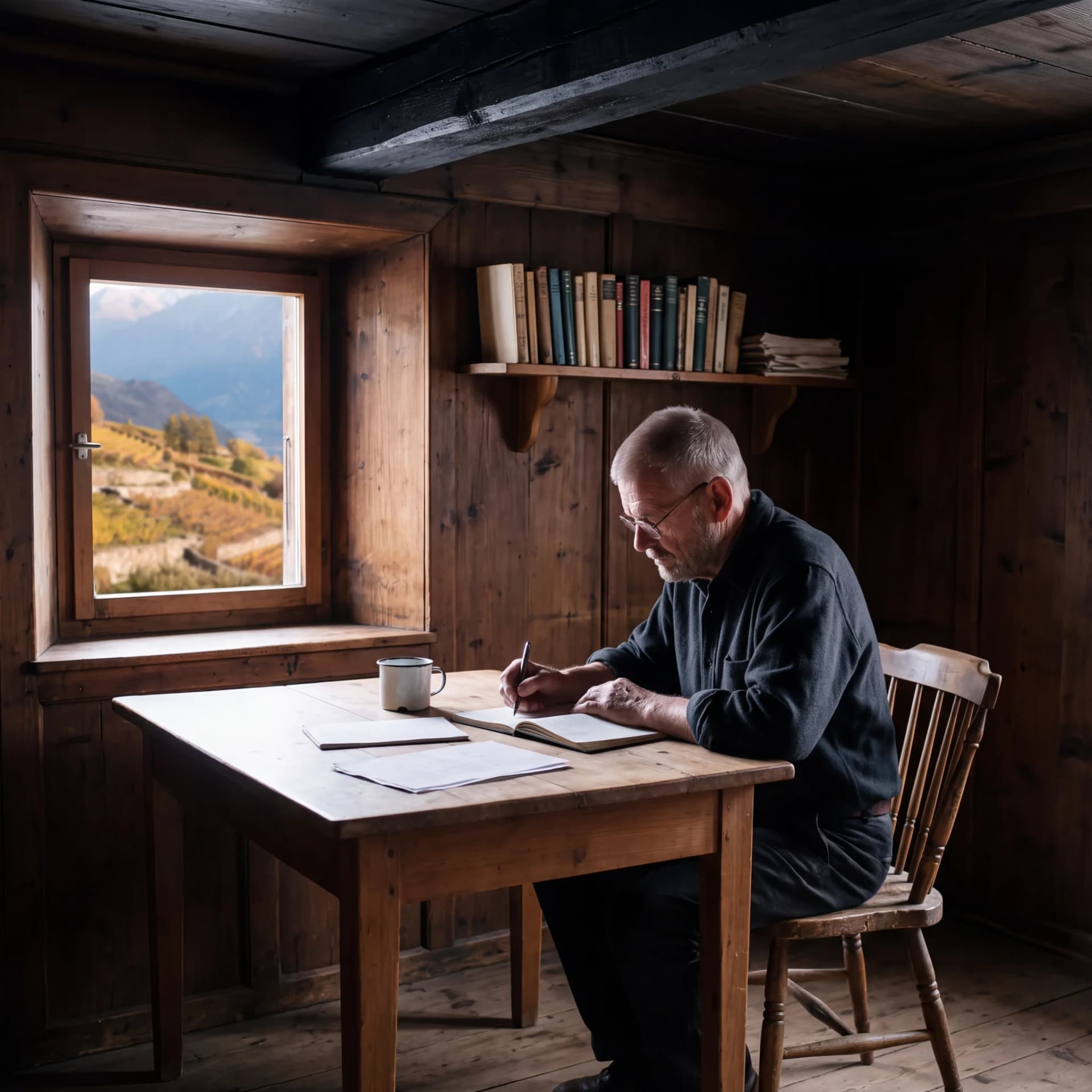
It reads faster than I do and it does not get tired. It drafts, and I cut. It writes my letters in French, which is better French than mine. It suggested which historians to approach and which archive holds what, and it was right often enough to be useful and wrong often enough that I check. The images on this site were generated from written briefs. The music was generated from written briefs. It argues with me, and it does not stop when I would rather it did.
What it does not do is decide anything.
The subject is mine. The questions are mine. Every ruling on this site — what goes in, what is cut, what is named, what is left unexplained — is mine, and where I have been wrong the mistake is mine and not the machine's, because the machine does not get a vote and has never asked for one.
And it cannot verify. That is the thing to understand about it. It can tell me what is usually said about the bisses of the Valais. It cannot tell me whether it is true. For that I have written to the Archives de l'État du Valais and to the museums, and I am waiting, and where an answer has not come back the passage is not published. There is material cut out of these essays that I would have liked to keep.
And nothing a machine made is allowed to carry a fact. There are no photographs on this site. No plate beside an essay carries a caption, a date, or the name of a place or a person. The prose carries the shelf marks and the pictures carry the air, so that when you disagree with me you are disagreeing with a sentence I wrote and can defend, and never with an image that cannot be cross-examined.
The novels
The first of the five novels, The Common Right, is published and free to read, and the other four are being written. The same machine has been in the room for all of them, and here is what it has done.
Not the sentences. What it has done so far is read the research and hold it together: argue the shape of the five books, keep the continuity document that every page on this site is checked against, and tell me — twice, flatly, and correctly — that a surname I had invented for a character belonged to a real family living in a real village up the valley.
It has also written documents that will appear inside the fiction, and that is the part a reader deserves to be told about. There is an act of 1430 in the first novel: a contract between a community and the man they hired to bring them water. The machine drafted it. The date is real, the form is real, the price in wheat and wine and florins is real, and the single standard the work had to meet — that the water should run well and with a proper descent — is real. The village is invented. So is the water, so is the master, so is the notary, and so is the clause the whole plot turns on. Where a novel of mine reproduces a charter, it is not a charter. It is a machine's reconstruction of a kind of charter, and I would rather say that here than have somebody carry a paragraph of it into an archive.
The essays and the fiction are held to opposite rules, and the reason is the same rule underneath. In the essays nothing may be invented. In the novels everything is, except the law and the villages and the water, and I have not moved a real family into a story or given an invented one a real name.
Where I have already said so
I would rather not ask you to take my word for this, so here is where the declaration already sits, in places written before anybody asked me for it.
It is in the letters to the archive. When I wrote to Sion asking them to check a document from 1448, the second paragraph said that the words are mine and the images and the music are made by a machine under my direction. I put it near the top rather than at the bottom, because an archivist who found it out later would be entitled to think less of me.
It is in the letters to the singers, where I asked whether anybody in the valley would lend a voice to a project made this way, and said so before I asked for anything.
It is in the audio files. Every piece of music on this site says inside the file how it was made. The tags carry my name for the words and the machine for the sound, and the description that travels with the file — written into three separate frames, because different players read different ones — states in plain English that the audio was generated. I edited those tags myself. I could have left that line out of all three. I put it in all three.
And it is on the video, where the platform asks whether the content is synthetic and I say that it is.
What this costs
Some people will stop here, and that is a reasonable thing to do.
I would only ask them to notice what the alternative would have been. I could have published all of this and said nothing. Nobody would have asked. The essays would have read the same, the music would have sounded the same, and the argument the novels make about machines would have arrived from a man who appeared to have made everything by hand.
That version would have been a better career move and a worse book.
The cards are on the table. That is all a loom ever was: a machine doing exactly what the cards say, in front of everybody, where the pattern can be checked against the instructions by anyone who cares to look.
Now the rings.