OR · P03
Whose Water
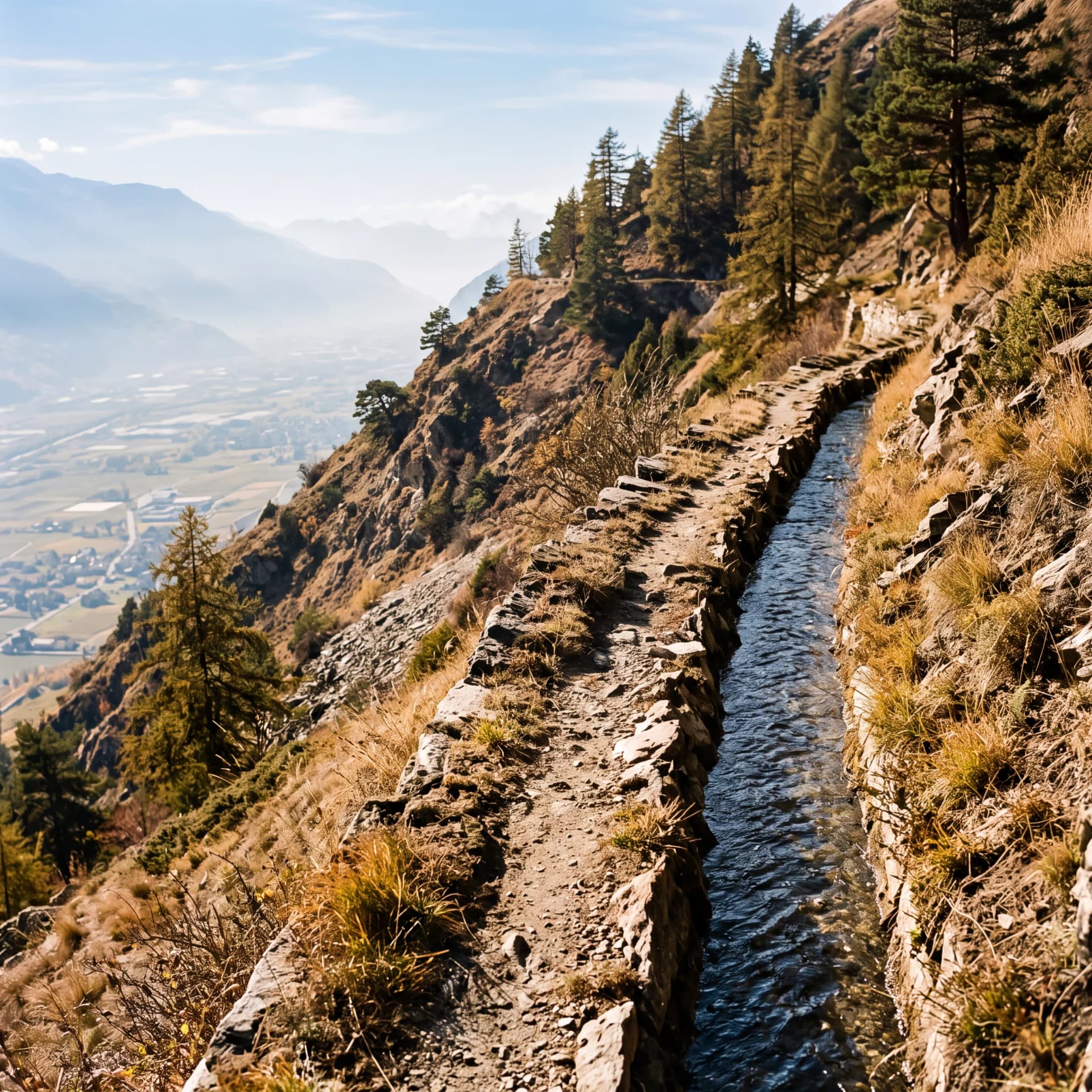
It does not rain here. Everything growing on these slopes is growing because somebody carried the water to it.
Where the record starts
The first written documents that mention the bisses date from the middle of the thirteenth century, and this is where the subject becomes interesting rather than merely impressive.
Those documents do not describe an invention. They describe a dispute, or a permission, or a contract — and when a new channel is agreed, the writing frequently refers to an older channel already there. The record begins in the middle of the argument. Whatever the origin of the bisses is, it is upstream of anything anybody wrote down.
The historian Pierre Dubuis has proposed an explanation for the great wave of building that followed. Until the middle of the fourteenth century the valley grew mainly cereals, and cereals here did not need irrigating. Then the plague came through and took a great part of the population with it. Ground that had been ploughed went over to pasture and hayfield. Livestock numbers rose. And a cow eats hay all winter, which means the hayfields have to be cut two or three times a summer, which means they have to be watered.
So the channels were dug — not out of ingenuity or love of the landscape, but because the alternative was a dead herd in February.
One of the earliest that can still be traced, the Bisse de Riederi running from Blatten down to Ried-Mörel near Naters, goes back to 1385 and was still in use in the nineteen-forties.
Who owns it
Here is the part I have not been able to stop thinking about.
A channel like this cannot be built by a family and cannot be maintained by one either. So the people who wanted the water formed themselves into an association — a consortage — and the rule was simple and brutal and has barely changed since. You owe the channel labour in proportion to the land you want it to water. Not money. Time. Your back, on the mountain, in the spring, alongside everyone else's.
At Ausserberg the constitution of the thing survives as three sets of wooden tally tokens. The first set records who owns what, in effect a land register. The second distributes the maintenance work, what each job is worth and who is answerable for it. The third fixes exactly how much water each member is entitled to, calculated against the meadows that member holds.
A cadastre, a labour roster and a water right. Three strings of carved wood, hanging on a wall.
And the whole arrangement was watched over by a person. Each bisse had its garde — its warden — who sometimes lived in a hut built beside the channel, and whose job was to keep the water running and to see that everybody got the share they were owed and no more. Some of those huts are still standing on the line of the channel.
I want to be careful not to make this sound gentle. It was not gentle. Water is a common resource here and its use is a matter of survival, and for centuries that combination produced exactly what you would expect: quarrels between neighbouring communities, litigation, and on occasion blood. Bishops and lords were repeatedly called in to separate people who had come to blows over a share of meltwater.
That is not a flaw in the system. That is the system having teeth. A commons only holds if breaking it costs you something, and here it cost a great deal.
1448
In 1956 the Tseuzier dam was built, and a commune wanted to sell water to the hydroelectric company that came with it.
The consortage said the water was not the commune's to sell.
The argument went to law, and the document the consortage produced was a paper from 1448. It was found to be legally valid. Five hundred and eight years after it was written, the paper held, and the water was ruled to belong to the consortage.
What happened next is the part that stays with me. The consortage now sells the water it does not use to the dam, and the money that comes back from that pays for the upkeep of the channel. A fifteenth-century agreement, still in force, is currently funding the repair of the thing it was written about.
What is left
The valley has changed around all of this. A great many bisses have gone, lost to modernisation and to an economy that no longer needs them, though you can still read some of their lines across a hillside if you know how to look. Many that survive are walked by tourists in summer, and a number of them earn their keep that way. At Ausserberg, where the three strings of tokens hang, there are now twenty-five part-time farmers and one full-time.
But the consortages have not gone. They are recognised as a living tradition of Switzerland. They still meet, still allocate, still send people up the mountain in the spring.
Eight hundred years of one question, asked every year in the same valley, and answered in writing every time by the people it fell on.
Whose water.