OR · P02
What I Can See From Here
From up here it looks finished. Ordered, even. A pattern laid down by somebody with a plan.
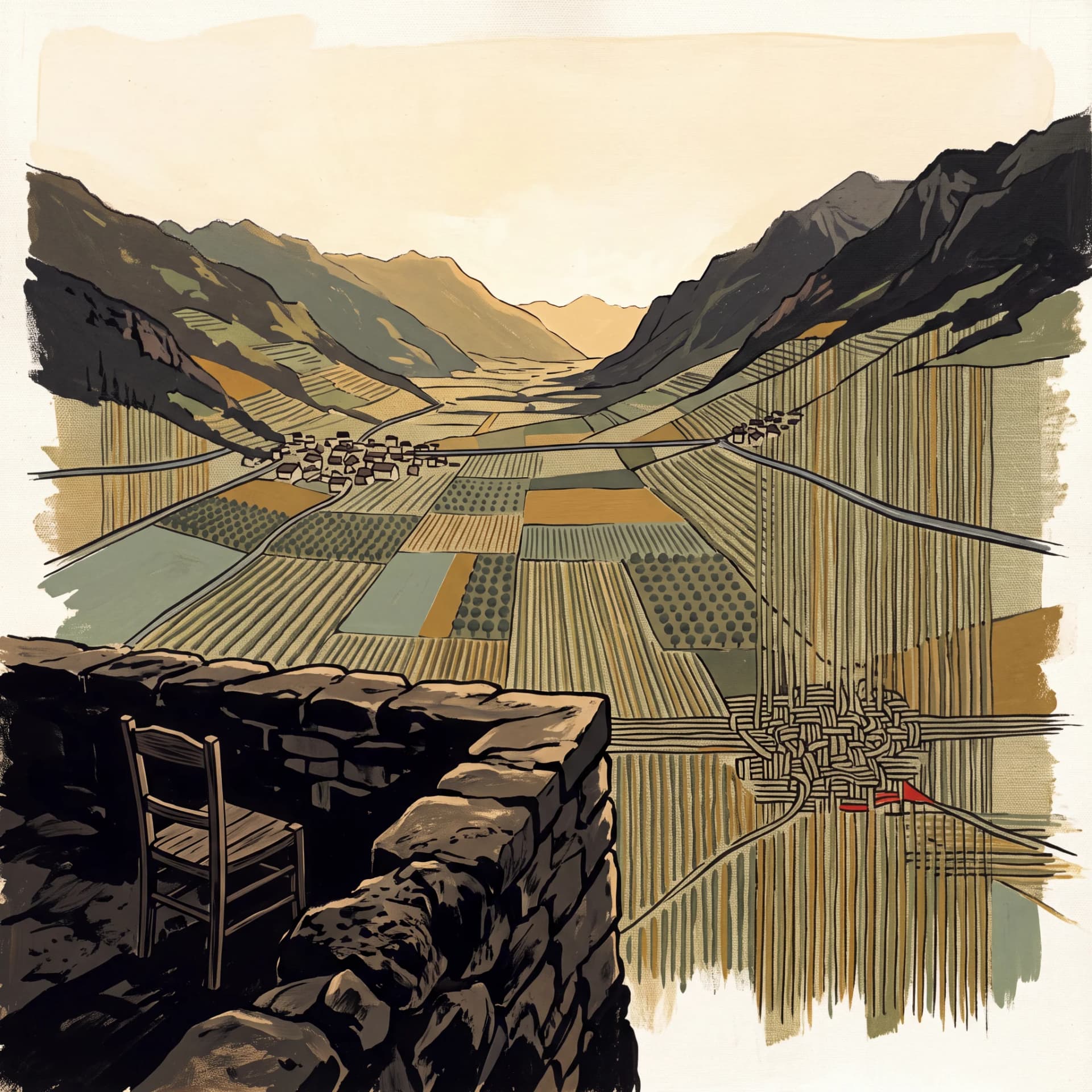
The valley opens below the terrace and closes again at both ends. Vines on the near slope, vines on the far one. The river somewhere in the middle, mostly hidden. Villages where the ground allows a village and nowhere else.
From up here it looks finished. Ordered, even. A pattern laid down by somebody with a plan.
There was no plan. Every one of those rows is on that slope because the slope was what there was. Nobody chose a gradient like that for the view. They chose it because the flat land was river and the good land was somebody else's, and because a vine will take a hillside that will take nothing else. What looks like design from a terrace is three hundred years of people running out of options.
I made none of it.
I watch the seasons from a chair. The green comes up the mountain in spring and goes back down it in autumn, and I can see the whole thing happen without ever knowing which week it turned. Somebody is in every one of those rows while I am watching. From this distance I cannot see a single one of them.
That distance is the point, and it is the thing I have to declare before I write another word about machines.
The whole pattern at once
Because a machine sees the valley the way I see it. The whole pattern at once, from above, at no cost. It knows the shape of the year and nothing about the weight of a crate. And I am writing five novels about the benefits of that vision from the most comfortable seat in the canton, which you are entitled to hold against me. I call them Jacquard fiction, history woven into the future of AI, and The Loom says why.
Here is what makes it worth writing anyway.
Under the building site
In 1961, in the middle of Sion, some men were working on a building site and found a slab of stone with a person on it.
Not a body. A carving. A tall flat stone, shaped and dressed, with a human figure worked into the face of it — the outline of a head, a suggestion of eyes, patterned bands across the chest that are probably clothing, a belt, and on some of them a weapon. They are called anthropomorphic stelae, which is an archaeologist's phrase for stones with people on them.
Around thirty of them came out of that ground.
The site is called Le Petit-Chasseur. It is a megalithic necropolis: dolmens, burial chambers, a place for the dead, built and rebuilt across roughly seven centuries between about 2900 and 2200 BC. The stelae stood there, and were later broken up and reused as building material for the tombs that followed them. The people who put up those stones were already being recycled by the people who came next, four and a half thousand years ago, on the same patch of ground.
What holds me is not the age. It is where it was. Not a remote alp, not a cave in a side valley reached by a track. A building site, in the middle of the cantonal capital, in the way of somebody's foundations. Which means the necropolis had been sitting under Sion the entire time. Under the Roman town, under the bishop's town, under the nineteenth century, under whatever was standing there in 1959. Nobody knew. Everyone walked over it.
It was not found by archaeologists. It was found by machinery.
And in July 2019 six more standing stones were found in the same part of Sion, aligned, during construction work on a residential building. Fifty-eight years later, same city, same accident. I am not qualified to say what those six stones are or how they relate to the thirty, and I am not going to guess. But the shape of the event is not in doubt. Somebody wanted to put up a building, and the ground had ancestors in it, in a place where two generations of specialists had already looked.
That is not a story about carelessness. It is a story about density. There is a great deal down there.
Who does it belong to
The people below me have been sharing water for eight hundred years. Not by agreement, by charter. Written down, argued over, amended, enforced by neighbours against neighbours, and still running. The same for the alps and the herds. They worked out how to hold something in common, benefit from it, and stop any one man owning it, and they did it with paper and stone.
The rest of the world is now trying to invent that for machines, and calling it new.
So the question the Orchard asks is not whether the technology works. It works. The question is the one this valley answered a long time ago and everyone has stopped reading.
Who does it belong to.