OR · P04
The Seven
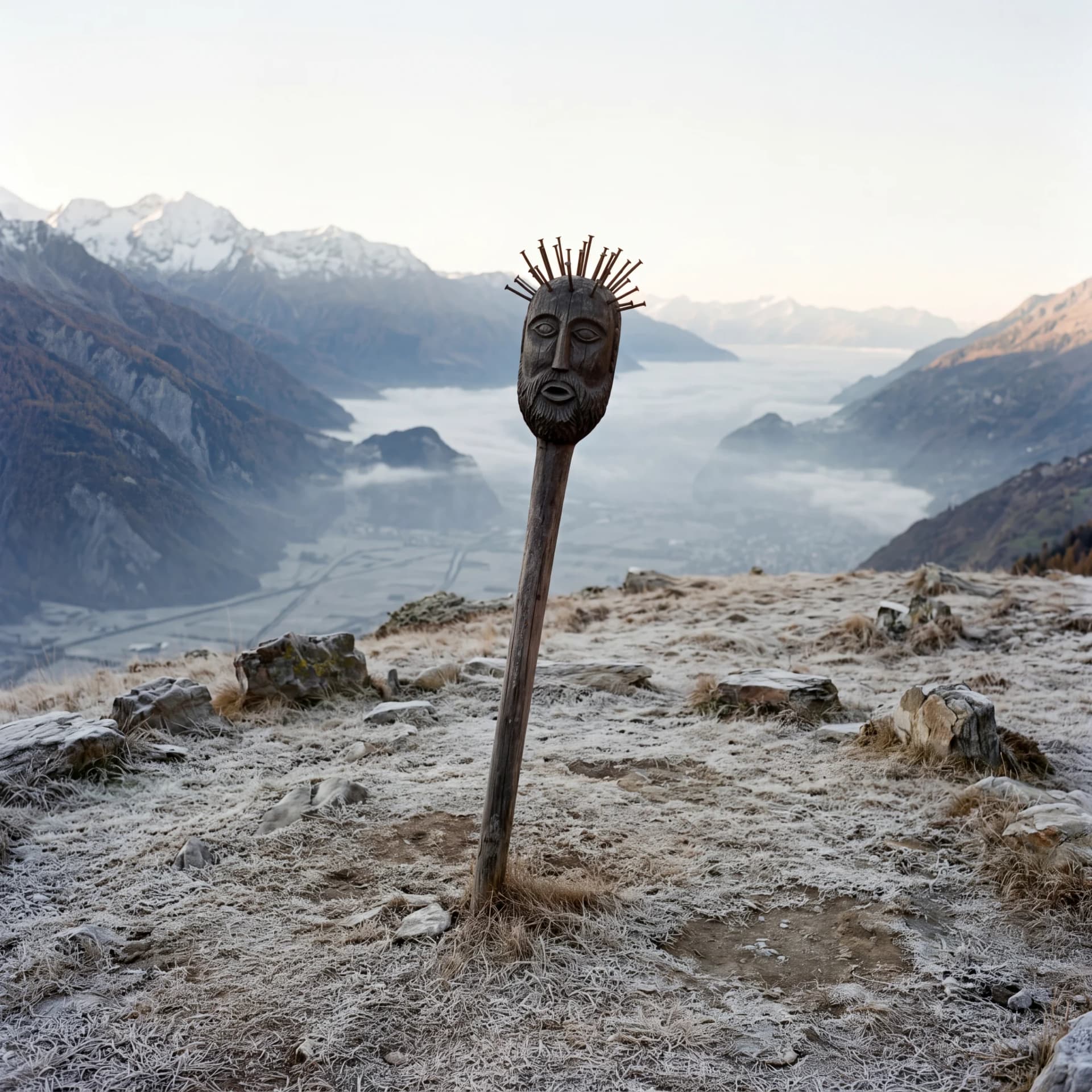
There is an object in this valley that people used to put up when they had had enough.
A canton with no prince
On paper the Valais had a lord, and he was a bishop.
The Bishop of Sion held the temporal county as well as the see, which made him a prince in the technical sense — a churchman with land, courts, revenue and soldiers. Red and white have been the colours of this valley since the bishops used them, from about 1220.
In practice, for three centuries, the communes took the country off him piece by piece, and mostly by argument.
They organised themselves into seven tithings — dizains in French, Zenden in German. Going up the valley they were Sion, Sierre, Leuk, Raron, Visp, Brig and Goms. Each was a community of communes with its own assembly, its own officers and its own say. They gained formal privileges from the Emperor Charles IV in 1353, and from there they simply kept going.
What they built is worth stating precisely, because it does not sound like the fourteenth century. Laws were debated and voted on by the citizens themselves, in the open air, standing outside, and officials were elected the same way. Not a parliament of delegates. Not an estate of nobles advising a ruler. The men of the tithing, on a piece of ground, deciding by hand.
Historians count it among the earliest sustained experiments in participatory government in Europe. It ran, in one form or another, for centuries.
The long argument
The dates make it look like a series of events. It was really one argument, conducted very slowly.
By the second half of the sixteenth century the tithings were exercising real sovereignty over their own territory. In 1613 the bishop was obliged to give up his claim to temporal power. He got it back briefly, and lost it again in 1634, and that time it was permanent.
And somewhere in the middle of that, in a document of 1619, the communes of the Valais describe themselves — in writing, in their own words — as a democratic Republic.
I have read that sentence several times. It is thirteen years before the birth of Locke.
Their seal, cut in 1582, carries seven six-pointed stars. Three on one side, three on the other, and one in the centre.
Why you would still need the Matze
Here is what I did not expect.
You might assume that a people who vote on their own laws in the open air have no use for a carved head on a pole. If you can outvote a thing, why threaten it?
But the assemblies decided; they did not always decide well, and they did not always decide for everybody. A tithing could be captured by a family. An officer could be bought. A neighbouring district could carry a vote that ruined you. The vote is a mechanism for settling a question, and the Matze is what you reach for when you no longer accept that the question was settled honestly.
So it sat alongside the institutions rather than outside them. Self-government and the standing threat of revolt were not opposites here. They were two parts of the same arrangement, and everybody understood the relationship between them, which is presumably why it worked as long as it did.
There is something else in it too. The Matze names no leader. It is a face, and the face belongs to nobody. Whoever raised it took a risk; whoever hammered a nail took the same risk, visibly, in front of the others, and then the object itself carried the count. A movement with a head made of wood cannot be decapitated in the usual way.
What is left
The Republic of the Seven Tithings did not survive the French. The old order went in 1798, and the Valais that came out the other side was a different construction.
The tithings are gone as institutions. The Matze is in a museum. The bishop is a bishop.
The stars are still on the arms.