OR · P05
The Year
There is a word here for a place you do not stay.
There is a word here for a place you do not stay.
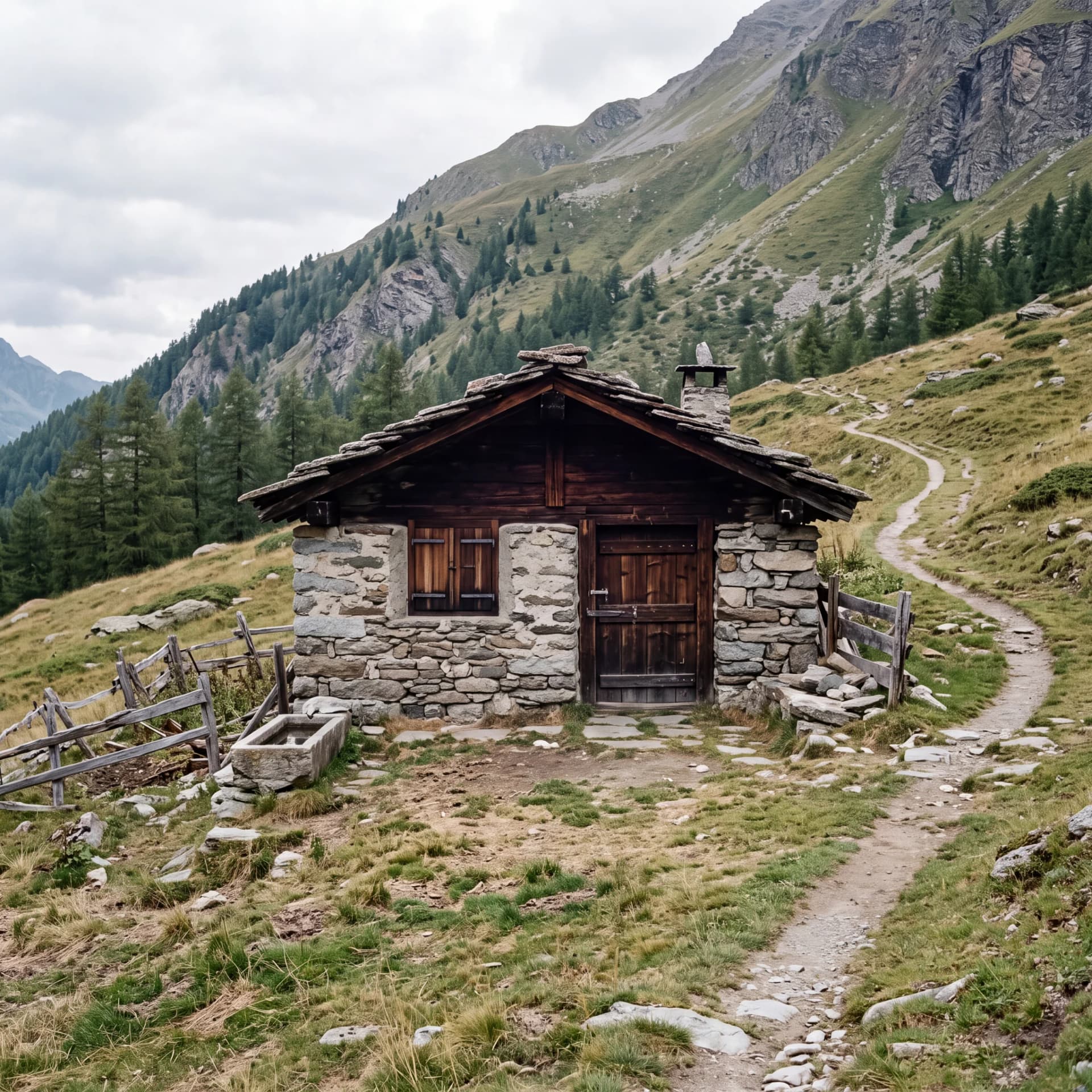
A remointze — the patois; remuage in French — is a pasture high on a mountain where a herd is kept for a while and then moved on, according to how the grass is coming. Not a destination. A stage. The word survives on maps as the name of actual places, which means somebody once had to write down, officially, the name of a field whose defining quality was that nobody remained in it.
That is the whole of this essay. Up here the year was not a calendar. It was a route.
The route
The pattern belonged to the western Alps, on the slopes of the great inner valleys — Valais, and the Maurienne and the Tarentaise over the border. It is not quite transhumance, which is only one component of it. It is a staged migration in both directions, up and back down, with halts.
In May the cattle leave the village stables where they have wintered, somewhere between five hundred and a thousand metres, and go up to the mayens — the intermediate holdings, the montagnettes, between roughly twelve hundred and two thousand. They stay until the end of June. Then the inalpe, up to the alpage above two thousand, where they remain until the end of September. In October they come back down to the mayens. Then to the ground around the villages. Then, in November, into the winter stable.
And it was not only the animals. Whole villages moved, two or three times a year, with the herd.
Read that again, because it is easy to skim. Not a herdsman and a dog. The household. Twice or three times a year, up and back, for centuries, because grass at one altitude runs out at exactly the moment grass at the next altitude becomes worth eating, and because a family that stayed put would have had one season's fodder and then nothing.
What the movement made
Once you know about the movement, a great many other things stop looking like customs and start looking like consequences.
Cheese is made high, at the alpage, in the summer. Not for flavour and not for tradition — because milk cannot walk down a mountain, and cheese can. The whole apparatus of the alpine dairy exists because a cow at two thousand metres produces something perishable four hours from anywhere.
Wood is cut in the season when the herd is somewhere else and the labour is free. Wool is carded and knitted in the months when nothing grows and nobody can work outdoors, which is why the crafts that look decorative in a museum case were originally what winter was for. Washing, spinning, mending, repairing tools: all of it scheduled by an agricultural year that moved people up a mountain and back.
The trades that turn out for a village parade today — the cheesemaker, the woodcutters, the washerwoman, the carder, the knitters — are not a costume selection. They are a functioning economy, arranged by altitude and season, and everybody in it knew exactly which month they belonged to.
Recently
Above Sierre there is a marked route called the Chemin de la Transhumance, which runs from the Crans-Montana plateau down to Salgesch. It is laid out as a year rather than as a walk: each halt on it corresponds to a period of the season, from the plain up through the villages and the mayens to the alpages, and back. At one of the stops there is an ecomuseum given over entirely to the remuage.
And in the material describing that route there is a sentence I have not been able to put down. It says, in effect, that the reading of this mountain as a place of rest and leisure — the Crans-Montana plateau in particular — is recent. Until the early twentieth century these valleys lived in near-autarky.
That is within living memory of somebody's grandparents.
The plateau I look at from a terrace, the one that reads as a holiday, was a working stage on a migration inside a hundred years. The chalets were not built for views. They were built where a family had to sleep in June because that was where the grass was.
The shape of it
I have been trying to work out why this arrangement moves me more than the water does, and I think it is this.
The bisse is an achievement — a thing built, and defended, and written down. The remointze is not an achievement. It is an accommodation. Nobody chose it, nobody is proud of it, and there is no charter for it. It is simply what the shape of a mountain does to the shape of a year when people have to eat.
And it has a form that a calendar does not have. A calendar is a line. This was a circuit — up, up, down, down, and back to the same stable in November, with everything you own moved twice on the way.
Nobody who lived here stayed anywhere.