Marginalia · Justice
JU · P06
The Delay
Suffer any wrong that can be done you rather than come here.
That is not a character speaking. Dickens says it is the warning any honourable practitioner would give, and does often give, about the court he works in.
He knew. He had been a court reporter in Chancery from 1829, at seventeen, and he had watched it at close range for years before he wrote a word of this.
What Chancery was for
This is the part usually left out, and without it the chapter is just weather.
Chancery was the merciful jurisdiction. It existed because the common law was rigid — the wrong form, the wrong words, the wrong day, and a person with an unanswerable case lost it on the paperwork. Equity was invented to reach past that. It was the court of conscience, set up to do what was right when the rules produced something that was not.
So the institution in this essay is not a bad court that ought to have been a good one. It is the good one. It is what was built to correct the failures of the other, staffed by people who understood that, working within it.
The suit
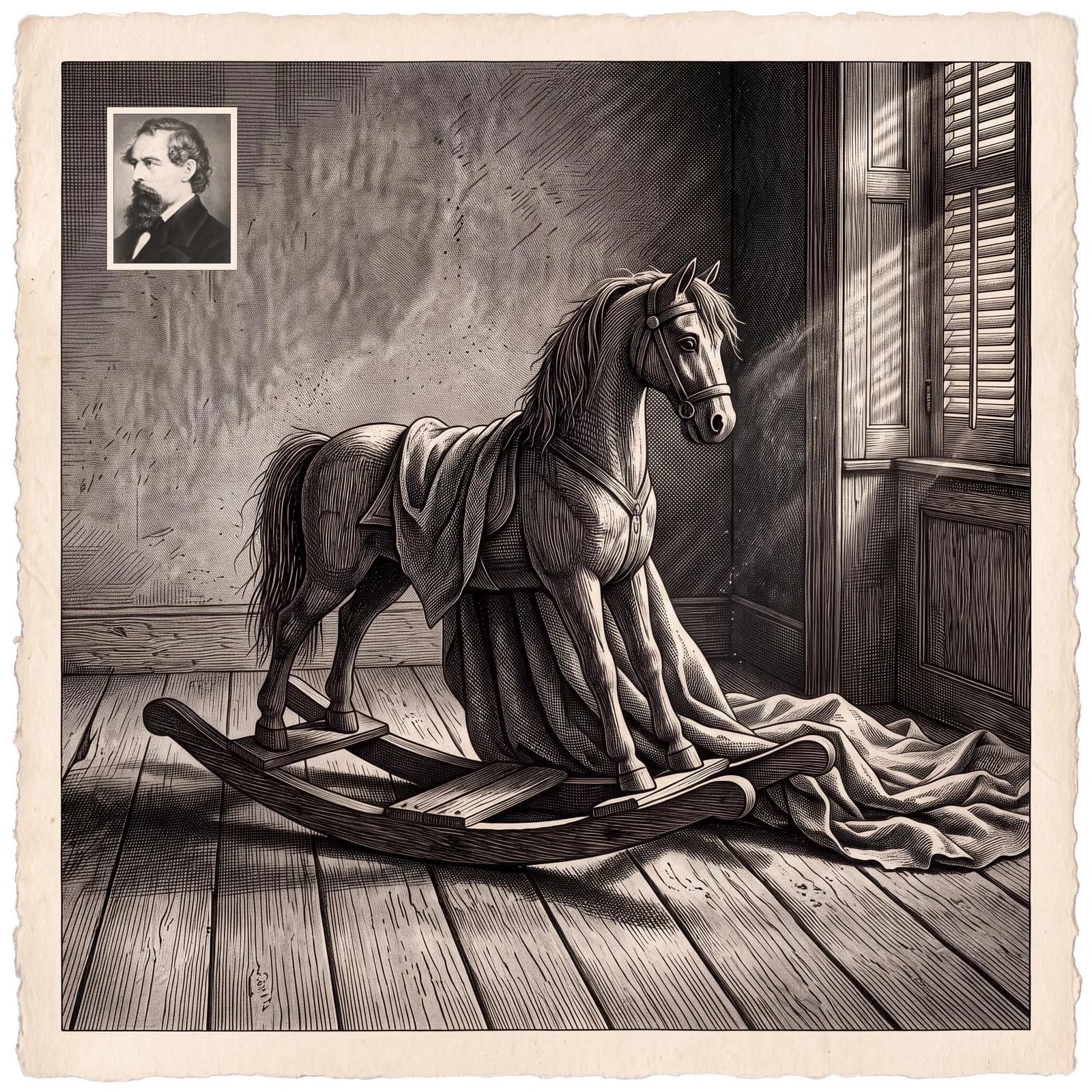
Jarndyce and Jarndyce has run so long that no living person knows what it means. The parties understand it least. Children have been born into it, married into it, and died out of it. Some people have found themselves made parties to it without knowing how or why. The child promised a rocking-horse when the case should be settled grew up, bought a real horse, and rode off into the next world.
And when the correct heirs are finally established, there is nothing to give them. The costs have eaten the estate. The case does not conclude. It is abandoned, because there is no longer anything to argue about.
Nobody in it is corrupt. That is the point of it and it cannot be said often enough. Every fee is lawful. Every adjournment is properly granted. Every document is filed correctly by a clerk doing his job to a standard nobody could fault. There is no step in the whole century-long ruin at which a person did a wrong thing.
The invention
What Dickens found is an injury with no author.
An outcome produced entirely by process — where each decision is defensible, the sum of them is catastrophic, and there is nobody to accuse. You cannot appeal against an adjournment. You cannot prosecute a fee schedule. Delay is the one punishment that requires nobody to impose it, and the only one that can be inflicted for a hundred years by people who have never met you and would be shocked to hear they had done anything at all.
It also has a property no other punishment has: it is indistinguishable from the process working. A case that is proceeding slowly and a case that is being destroyed look identical from inside, and the difference is only visible from the far end, by which time it is not a distinction that helps anybody.
It was not an exaggeration
Readers assumed Dickens had inflated it for effect. He had not, and he said so.
Jennens against Jennens, a dispute over the will of a man who died in 1798, was commenced that year and was still running when Bleak House appeared fifty-five years later. It was finally abandoned in 1915 — one hundred and seventeen years — when the legal fees had consumed the estate entirely and there was nothing left to distribute.
The satire was outlived by its subject by sixty-two years.
What it becomes when the waiting is removed
Now the part that makes this page necessary rather than merely enjoyable.
The obvious reading is that Jarndyce is a story about slowness, and that any system fast enough is cured of it. Instant determination, instant review, no fog, no clerks, no century.
That reading is wrong, and the speed is not what did the damage. What did the damage was provisionality. For a hundred and seventeen years the Jennens estate was not lost and not awarded. It was pending. Nobody could plan around it, spend against it, mourn it or move on from it, because at every moment it remained an open matter which might resolve, and a life was lived in the space that left.
Remove the delay and keep the provisionality and you have not fixed anything. You have made it efficient. A determination that stands, subject to review, with the review available at any time, without limit, without fee — and with the determination continuing in force throughout, because suspending it would leave the person worse served while they contest it.
Every clause of that is humane. It is also Jarndyce with the waiting removed and the outcome unchanged, and it can be maintained indefinitely at no cost to anybody except the person inside it.
How the case ended
Not with a judgment. Chancery never said who was right.
It ended when the estate was exhausted — when there was no longer enough left in the pot to pay for another year of arguing about it. The case did not conclude. It ran out.
That is worth holding on to, because it is the answer to what a process like this is actually for. It does not exist to reach a wrong result. It exists to continue, and it stops when the thing it is consuming is gone.
Applied to money that is a scandal in a newspaper. Applied to a person it has another name, and Dickens gave it: the worn-out lunatic in every madhouse, the ruined suitor borrowing and begging through the round of every man's acquaintance. Miss Flite has already lost her mind on page one. Richard Carstone dies of the case.
One hundred and seventy-three years
The court that was built to be merciful gave to monied might the means of wearying out the right. That is Dickens's phrase, and it is a better description of most modern process than most modern process has produced about itself.
Nothing about it required a villain. It required only that the machinery continue and that somebody be inside it while it did.
It never decided against them. It simply never decided, and they were the ones who could not wait.
JU · P06 · Robert Anthony