Marginalia · Justice
JU · P05
The Visit
All I tell thee is a faint picture of reality.
A family friend called Stephen Grellet had been into Newgate and come out shaken, and he told her that the women's side was worse than what he had seen.
She went.
Three hundred women and their children, in two wards and two cells. Some convicted, some still awaiting trial, no distinction made between them. They cooked, washed, slept and died in the same space. There was no bedding to speak of and not much clothing. Some of the children had been born in there and had never been anywhere else.
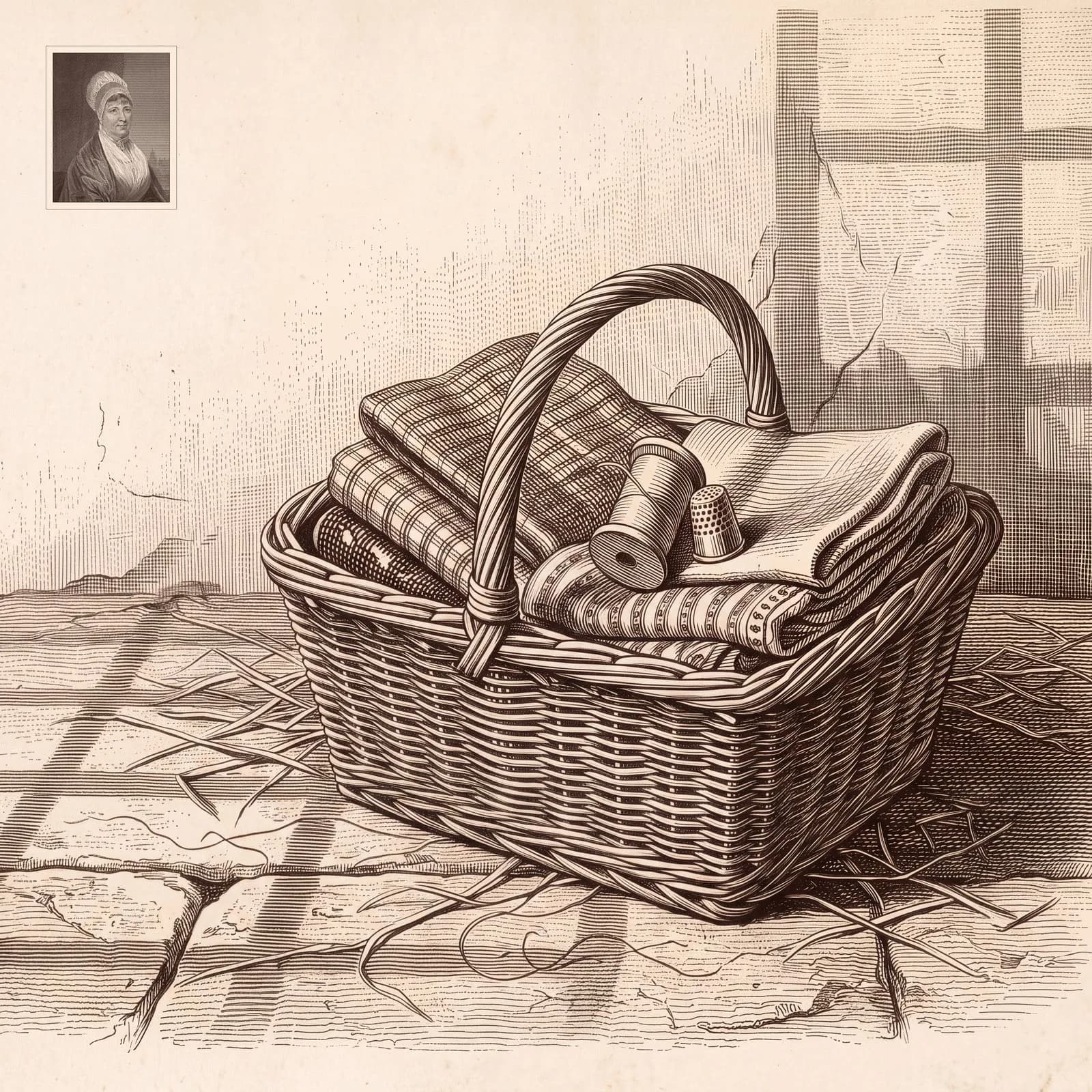
She called it hell above ground, and she went back the next day with clothes.
What she did that nobody else did
Charity was not unusual. Wealthy women visiting prisons with baskets was, by 1813, an established form of respectable activity, and it changed nothing because it was not intended to.
Fry did something else, and it is the reason she is on this page rather than in a footnote about philanthropy.
She asked the prisoners first. Before she approached the authorities, before there was an association or a committee or a single letter to anybody, she went to the women themselves and put her proposals to them and secured their agreement. A school for the children, work they could be paid for, a matron of their own, rules they had consented to. She then trained the matron, brought the work in, and ran the thing quietly for a considerable time before letting the prison officials see it.
In April 1817 she brought them in to look. The men were astonished.
She wrote it down
The second thing she did was to record. Not impressions — numbers, conditions, arrangements, what the allowance of bread actually was, how many to a ward, what happened on the walk from the prison to the transport ships.
A record can be read into a committee. In 1818, through her brother-in-law Thomas Fowell Buxton, then a Member for Weymouth, she gave evidence to a House of Commons committee on the state of the prisons — the first woman ever called to do so. She was thirty-eight, a Quaker, the mother of a very large family, and she had a document.
The Gaols Act followed in 1823: women held separately from men, women's wards supervised by women, iron manacles prohibited, and the death penalty removed from something on the order of a hundred and thirty offences.
Whatever else is said on this page, that happened, and she caused it.
What persuaded them
Here is the part that belongs in this section rather than in a life of a good woman.
When the officials were finally shown the women's side in 1817, what struck them was not that the children were being taught, or that the sick had blankets, or that women awaiting trial were no longer held with the convicted.
What struck them was that the women were quiet. Orderly. Sober. Not fighting.
That is what carried the argument, and everybody involved knew it. The association's own stated aims are explicit: to provide clothing, instruction and employment, and to form in the women those habits of order, sobriety and industry which would render them docile while in prison and respectable when they left it.
Docile is in the founding document. Not smuggled in by a hostile critic two centuries later — written down by the reformers, as an objective, in the sentence explaining what the work was for.
The measurement problem
A prison's conditions state its purpose more honestly than its statute does. That is the argument this page was chosen for, and it holds: the 1834 workhouse a few years later was designed, on the record, to be worse than the worst life available outside it, and the design brief is the truest description of the policy anybody wrote.
But there is a second thing here, and it is sharper.
A reform states its purpose in the metric it selects. Fry could have argued for the changes on the ground that the women were human beings and the conditions were an outrage — and she believed exactly that, and said so, and it moved nobody with power. What moved them was a measurable improvement in behaviour.
So the case that succeeded was the case that treated better treatment as an instrument. Not: this is owed. But: this works, look how quiet they are.
Every subsequent argument for humane treatment has had that shape available to it, and has mostly used it, because it is the shape that wins. It also concedes the whole question in advance. An argument from results can be defeated by better results, and sooner or later somebody arrives with a cheaper way to produce quiet.
What was hers and what was taken
The thing she did that has not survived into anything since is the first thing she did: she asked the women, and did not proceed until they had agreed.
Every element of the Newgate scheme — the school, the matron, the paid work, the rules — was consented to by the people it applied to, before it was shown to a single official. That is not philanthropy. It is a small, temporary, entirely unofficial constitution, negotiated inside a prison, by a banker's wife and three hundred women who had no standing of any kind.
What the Gaols Act took up was the separation, the female warders, the removal of the manacles. All good. None of it consented to by anybody inside.
The reform kept the arrangements and dropped the asking, which is the same edit that was made to Bentham one page earlier, and it is beginning to look less like coincidence.
Two hundred and thirteen years
She toured the country and the continent. Prisons across Europe were altered on her model. For more than twenty-five years she went aboard every convict ship leaving for Australia. In 1825 she published a book on the government of female prisoners that told administrators precisely how to do it.
She was on the five-pound note from 2002 until it was withdrawn in 2016, the only woman other than the Queen to have appeared on a Bank of England note.
She asked them what they wanted. It is the only part of the scheme nobody adopted, and the only part that could not be done to anybody.
JU · P05 · Robert Anthony