Marginalia · Justice
JU · P02
The Question
made slaves, being as free as I am
He wrote that about the people of Nicaragua, in a book published the year after the debate, and it is the answer the debate declined to give.
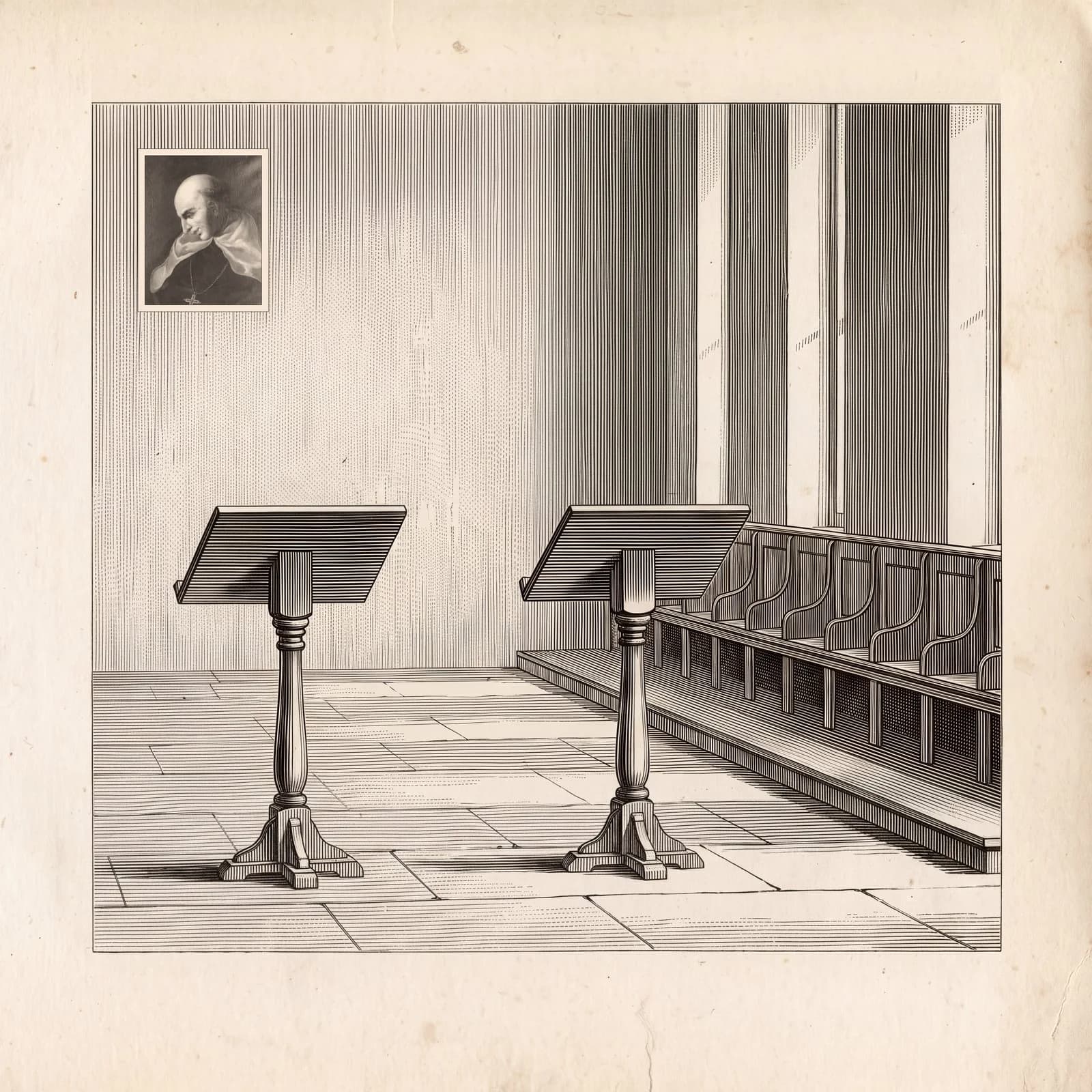
The Emperor convened it. Fourteen theologians and jurists sat at the Colegio de San Gregorio in Valladolid, in sessions running from August 1550 to May 1551, and the matter before them was this:
Whether the people of the Americas were fully human.
Not whether they were being treated badly. That was not in dispute; everybody in the room knew what was happening in the Indies and a good deal of it had been documented by one of the two men arguing. The question was prior to that, and it was procedural, and it was asked in exactly the tone you would use to settle a boundary dispute.
The case against
Juan Ginés de Sepúlveda was a serious scholar. It matters that he was, because a foolish man on that side of the argument would let everybody else off.
His authority was Aristotle, and the doctrine of natural slavery: that some men are so constituted that they are better governed than governing, and that for such men subjection is not an injury but their proper condition. He argued that the customs of the Indies — human sacrifice, idolatry — were evidence of exactly that incapacity, and that conquest which brought such people under Spanish rule was therefore lawful, and being lawful was also merciful.
The argument is disgusting and it is not stupid. It cites its sources. It proceeds by steps. It is the kind of case that can be made in a formal setting to educated men without anyone in the room feeling that the tone has slipped.
The case for
Las Casas argued that the peoples of the Americas were fully rational, capable of self-government, possessed of natural rights that did not depend on their religion, and that wars waged to subject them were therefore unjust in every instance and could not be made just by their outcome.
He had the facts on his side and he used them without restraint. His account of Hispaniola — over three million souls when he saw it, and two hundred of the island’s own people left by the time he wrote — is in the Brevísima relación he published the following year, and it did more to shape what Europe believed about the conquest than the debate itself ever did.
What the proceeding was actually like
They did not face each other. This is worth knowing, because every dramatised version has them across a table.
Each addressed the junta separately. Sepúlveda summarised his position; Las Casas read from a written apology across several days, at length, in Latin. Domingo de Soto then prepared a summary of the arguments so that each man could respond to the other's case in writing. It was correspondence conducted in a room, with intermediaries, over months.
And at the end of it, the junta did not find. There was no verdict, no ruling, no published determination of any kind. The members went home. Both men afterwards claimed to have won, which is what happens when nobody says who did.
What that means, exactly
The machinery worked perfectly. It was properly convened, competently staffed, argued at length on both sides, minuted, and summarised by a respected jurist.
It produced nothing.
Neither man got what he wanted. The conquests did not stop. The encomienda was not overturned. And the question — whether a category of person is fully a person — was left in exactly the condition a question is left in when a body of learned men considers it carefully and declines to answer: open, respectable, and available to be asked again.
That is the finding of this page. Not that the wrong side won, because no side won. It is that the question was askable. That a civilised state, at the height of its power, could put the humanity of several million people on an agenda, hear submissions, and adjourn.
Who was not in the room
Nobody from the Americas.
Not as a witness, not as a party, not as an observer. The rationality of a people was argued in Castilian and Latin, in a Spanish college, by two Spaniards, before fourteen Spaniards, and the people whose rationality was in question were four thousand miles away and were never told it was happening.
Everything else on this page is history. That part is not. A determination about a person's standing, conducted properly, by qualified people, in a room the person cannot enter and in a language chosen for the room, is not a sixteenth-century practice.
The man who argued for them
Las Casas arrived in the New World as a settler. He held an encomienda — land, and the labour of the people on it — and he worked it like his neighbours, and he was a priest while he did it.
In 1514 he gave it up, publicly, and spent the following fifty-two years arguing the case that made him famous. That is the version that gets told.
Here is the part that belongs on the page. In his early campaigning, seeking some way to relieve the people he had come to defend, he proposed that African slaves be imported to do the work instead. He came to regard this as the worst thing he had done, wrote so in his history, and said plainly that he had been ignorant and that the injustice he had proposed for one people was the same injustice he was condemning for another.
It should not be tidied away and it does not cancel him. It is the same shape as Kant's problem, four hundred years earlier: a man who states the principle further than anyone around him and then fails to see where his own line falls. The difference is that Las Casas noticed, and said so, in writing, against himself.
Four hundred and seventy-five years
The junta at Valladolid is often described as the first time a European power formally debated the rights of the people it was conquering, and that is true and is usually said admiringly.
Read it the other way. The first time the question was formally asked, it was formally not answered — and the asking of it, in a proper forum, with proper argument, by men of standing, established that it is the kind of question a serious body may consider.
It has been considered many times since. The vocabulary improves in every century.
They did not decide that some people are not people. They decided nothing, which left the question open, and it has never once been closed.
The question was put to a properly constituted body, argued for nine months by learned men, and no finding was ever issued.
JU · P02 · Robert Anthony