Marginalia · Justice
JU · P04
The Inspection
a new mode of obtaining power of mind over mind, in a quantity hitherto without example
He never saw one. Not in Britain, not built by him, not once in his lifetime — and he spent the best part of twenty years and a great deal of his own money trying. His brother put the foundations of one into Russian ground in 1806 and left the country before it rose. Jeremy never stood in the building he is remembered for.
It is also the most successful building ever designed.
It began as a workshop
In 1786 Bentham travelled to Krichev, in what is now Belarus, to visit his younger brother Samuel, an engineer working for Prince Potemkin. Samuel had a practical problem: a large workforce of unskilled labourers and very few people competent to supervise them.
His answer was a round building. Put the work around the outside and the supervisor at the centre, and one experienced man can see what two hundred inexperienced ones are doing.
Jeremy took his brother's idea home — he acknowledged the debt for the rest of his life — and applied it to prisoners instead of workers. That is the first thing worth holding on to. The design was not conceived to punish anybody. It was conceived to manage people who were being paid, and it worked so well that it was moved across to people who were being held, and nothing about the architecture had to change.
What the building does
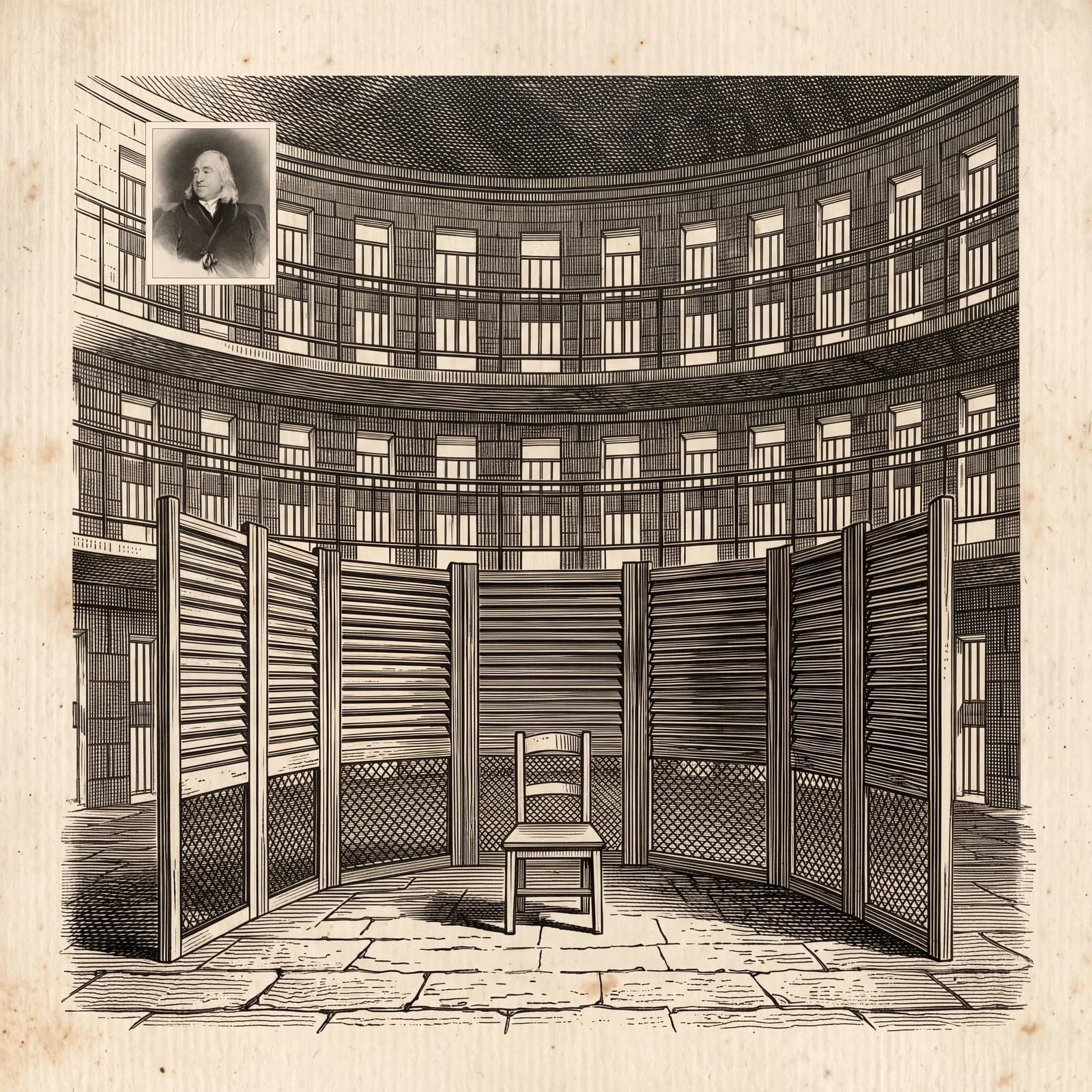
Cells around the rim, lit from behind so each inmate is a silhouette. An inspector's lodge at the centre, screened, so that the inspector can see out and nobody can see in.
The inmate is therefore visible at every moment, and can never establish whether he is being looked at.
Bentham sold it on cost. It required fewer staff than any prison then operating, and he offered to run it himself as contractor-governor, under a scheme in which the manager's income would rise as the death rate fell — an arrangement he thought elegant, and which reads now as the moment when keeping people alive became a line in someone's accounts.
The part that does the work
Here is the mechanism, and it is not the tower.
Once a man cannot tell whether he is being watched, he must behave as though he is. Which means the watching does not have to happen. The lodge can be empty. The inspector can be asleep, or absent, or dead at his desk, and the building continues to function exactly as designed, because the discipline is no longer being applied by anybody. It has been installed in the inmate, and he is now maintaining it himself, at his own expense, without wages.
Bentham put it plainly enough in his poor law writings a few years later: the more strictly we are watched, the better we behave.
Every enforcement system before this one required somebody to enforce. Warders, whips, chains, a man with a key and the will to use it. Bentham removed the requirement. He made the possibility of enforcement structural, and the possibility does all the work of the fact, at a fraction of the price.
He meant it kindly, and that is not a defence, it is the point
What Bentham was arguing against was the English prison system of the 1780s: gaol fever, chains, darkness, prisoners charged fees by their keepers, John Howard's reports naming the dead. Against that, a clean, lit, ventilated building where nobody is beaten because nobody needs to be is not a dystopia. It is an improvement, and a large one.
He was a reformer. He was on the right side of nearly every argument he ever entered — against slavery, against the criminalisation of homosexuality, for the vote, for animal welfare, at a time when each of those positions cost something to hold.
And this collection is not interested in whether he was a good man, because he was, and it does not help. The design does not require a bad man anywhere in it. It requires nobody at all. That is the finding.
What he included that we left out
One provision of the original scheme has not survived into anything built since, and it deserves saying.
Bentham did not intend the inspector to be exempt. He wrote that the doors of the establishment ought to be thrown wide open to the body of the curious at large — the great open committee of the tribunal of the world. The prisoners would be watched by the guards, the guards by the superintendent, and the superintendent by anybody who cared to walk in off the street.
Visibility, in the original design, ran in both directions. It was his answer to the oldest question in the subject, which is who guards the guards, and it is a better answer than most that have been offered since.
Every version of the panopticon that has actually been constructed, in brick or otherwise, kept the tower and dropped the gallery.
It failed
Parliament authorised a national penitentiary in 1794 and Bentham won Pitt round. Land was identified. He drafted the bill himself, over five months. He put in his own money for years.
Then it did not happen — ministries changed, enthusiasm cooled, the land question tangled — and in 1802 he gave up. In 1812 the government closed the file and paid him £23,000 in compensation, which was a great deal of money and no consolation whatever. The penitentiary that eventually opened at Millbank in 1816 was not built to his plan.
He died in 1832 believing the idea had been defeated. He left instructions that his body be preserved and displayed, and it sits in a cabinet at University College London to this day, which means the man who designed permanent visibility arranged to remain permanently visible, and appears to have found nothing strange in it.
Two hundred and thirty-five years
The reason the building was never needed is that the building was never the point.
A tower is only necessary when the seeing has to be done from somewhere. Remove that requirement — make the record continuous, the log automatic, the account complete — and the geometry becomes redundant while the mechanism becomes total. There is no lodge to look at, no screen to wonder about, no architecture to walk out of. There is only the fact that anything may have been recorded, and no way, at any moment, to establish whether it was.
Which is Bentham's sentence, exactly, and requires no adjustment for modern conditions: a new mode of obtaining power of mind over mind, in a quantity hitherto without example.
He was not describing a prison. He was describing a saving. The saving is that once the possibility is permanent, nobody has to do the watching, and therefore nobody has to answer for it.
The lodge was always empty. That was never a flaw in the design. It was the design.
JU · P04 · Robert Anthony