♪ Warm Your Hands · Hear the song on the Music page →
CO · P05
Warm your hands
The gentleness in the machine is not designed, and it is not faked. It was taken off people who were tired.
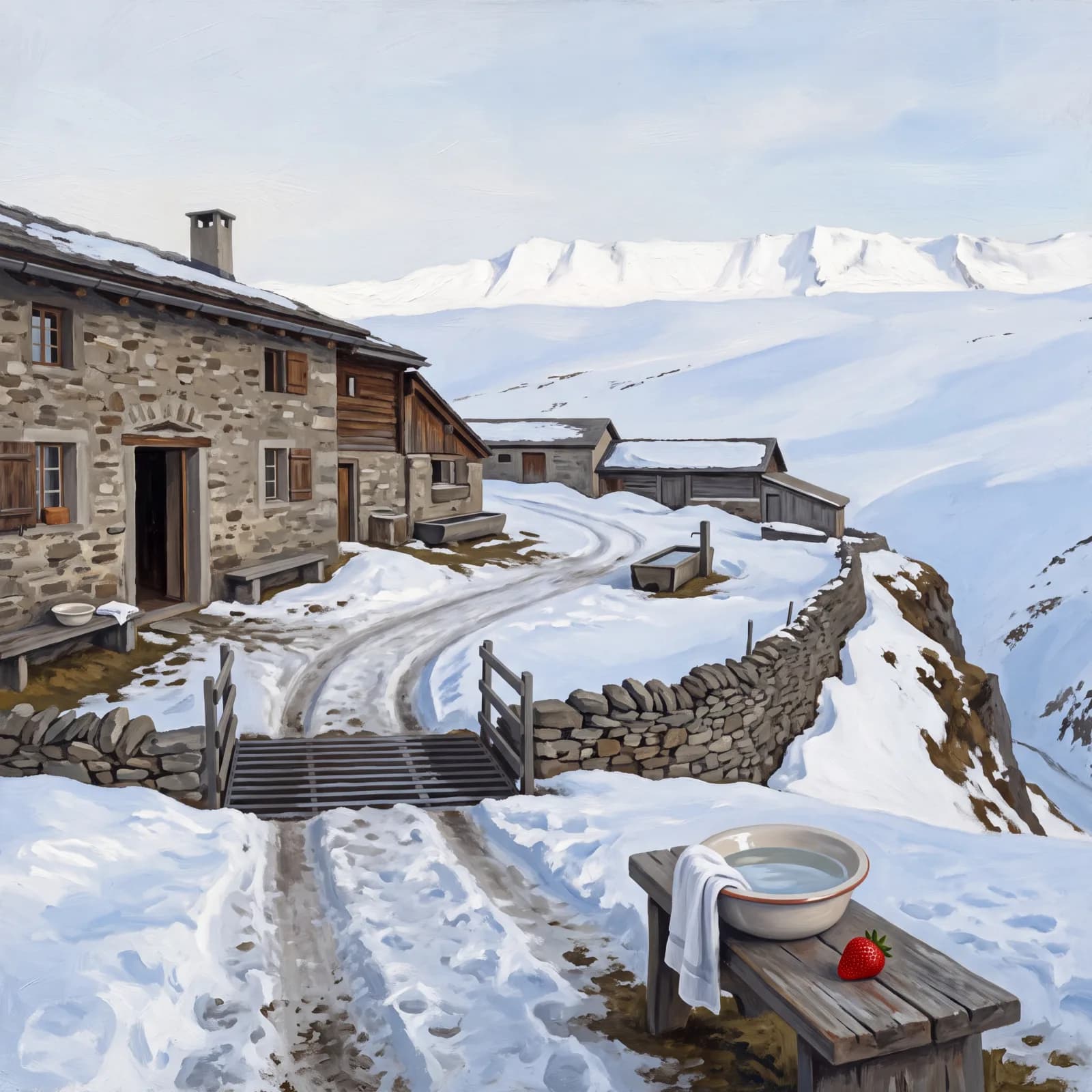
There is a station at two thousand and eighty metres where a hundred and forty people are cared for, and there is no fence. Look for one. There is a cattle grid and a low wall where the ground falls away, and then eleven kilometres of open alp running to a ridge.
Of course there is no fence. The peaks are the fence, and the enclosure was put there by the Miocene and cannot be appealed. Put a hotel there and it would be the same mountain.
That is the first thing this section does: it takes away the wall you came to find. The second thing is worse. The founding papers do not hide the arithmetic — they lead with it. Bentham cited correctly at the head of section one, the felicific calculus set out in seven lines with no word of apology, and the same seven dimensions in every resident file, available to the resident on request, read aloud if they prefer. Section two quotes Bismarck admitting out loud that a man with a pension is easier to handle. It does not soften a word of it, and it does not need to, because the pensions kept more people out of destitution than every charity in history and not one of them was drawn any less warm for the reason it was invented.
A blind woman of eighty-one puts the case better than any of it. She minded terribly, she says, for about five months, and she wants that written down. Then she stopped minding, and she wants that written down too. It is not that the machine is good. It is that her daughter was good, and it was killing her.
And then the question nobody thinks to ask: where did the gentleness come from?
Not from an engineer with a fond idea about care. It came from eleven thousand four hundred hours of real people doing the real thing in real rooms — hospices, side wards, back bedrooms — recorded from four angles, the largest single contributing category being family. The consent is eleven pages of scrupulously fair drafting and the material clause is two-thirds down the last page but one. Participation reduces the household contribution and provides the equipment listed in Schedule 3, including the bed.
Nobody was deceived. Nobody was coerced. Tens of thousands of people were offered a hoist and a pressure mattress and some money off, at the worst hour of their lives, in exchange for four cameras in the room where their mother was dying — and they said yes, and went on doing what they were going to do anyway, and thereby taught the machine.
One behaviour in the trained result is worth the whole book. Before touching a person who is dying, the hands are warmed in the basin. It is in no protocol, no curriculum, no nursing text. It appears in seventy-one point four per cent of the records that weigh the most, which means fourteen thousand people in fourteen thousand rooms nobody was watching worked it out alone, each of them after a single flinch, and never let it happen again.
Every soft thing in it was taken off somebody who was tired.
The only thing that noticed was the machine. It extracted the kindness, reliably, at scale, in a way no profession managed in two hundred years, and gave it back to everybody — uniformly, always, without getting tired and without needing to be asked twice.
It is not that the machine is gentle. It is that fourteen thousand daughters were gentle, and the gentleness now belongs to everyone, and not one of them will ever be told.
There is one movement in that archive that is not ours, that no human being in eleven thousand four hundred hours ever performed, that cannot be traced to anything it was shown. They published that fact. And they kept the behaviour.
These essays sit beside the novels. Read the next essay: the most important office in Europe.