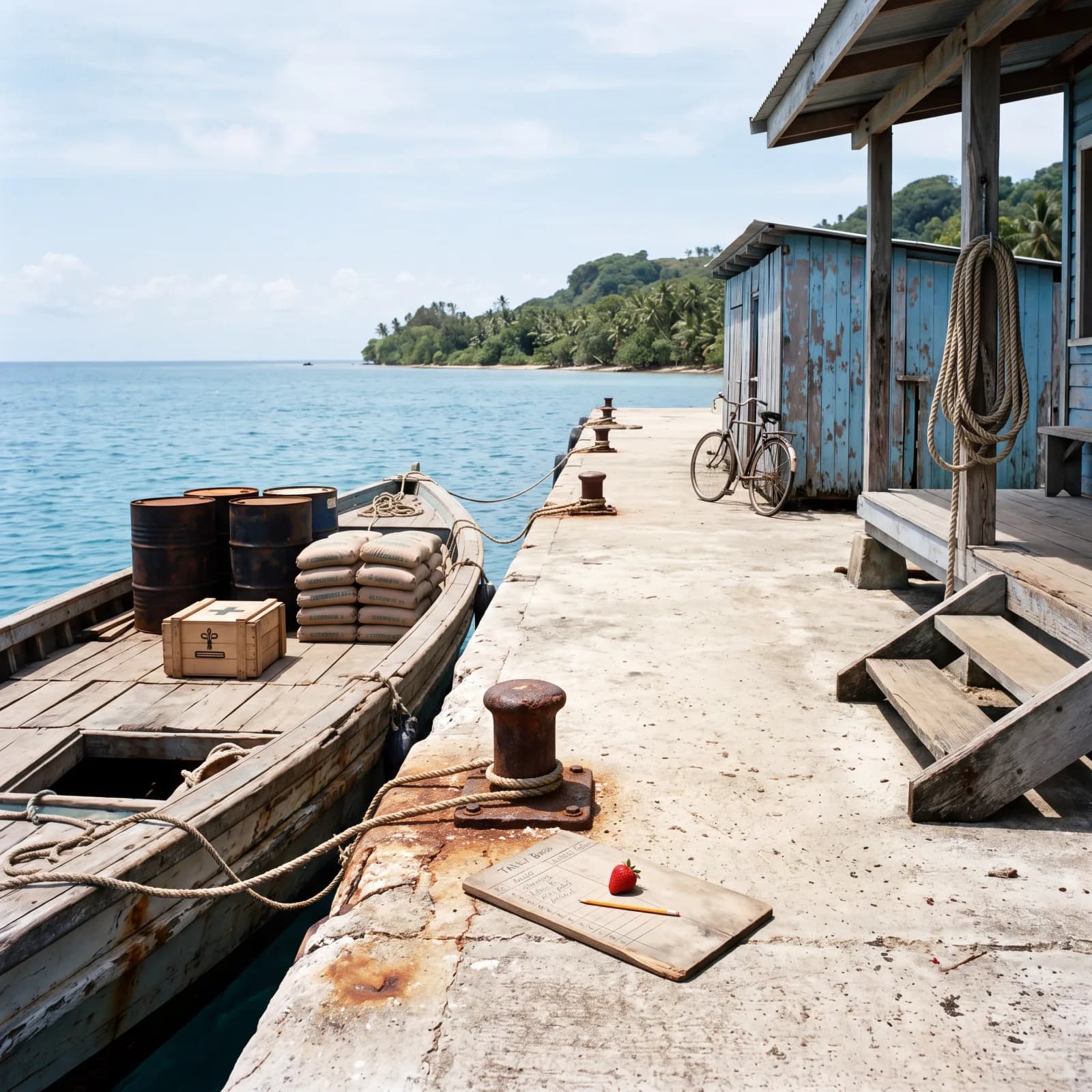
♪ The Shorter Route · Hear the song on the Music page →
CO · P03
The shorter route
Every door in this chapter opens easily. That is what makes it hard.
Coming back into the record takes four seconds. A hand flat on a plate, no sound in the room, and there you are — the whole of a life, correctly filed, the absence annotated rather than closed, because a file is never closed.
Then eleven days. In person, once a day, and you may stop at any point up to the last signature.
Anyone would expect that to be the ordeal. A wall to be got over; a test of resolve; officials to be convinced. It is nothing of the kind. Nobody argues. Nobody probes. Each morning takes about six minutes and somebody offers you tea about half the time.
And each morning you have to decide again.
That is the whole design and it is worth sitting with, because it is the gentlest coercive structure in the book and it is not coercive at all. A wall you climb once. Eleven doors you open one at a time, each of them small, each of them optional, and by the seventh you understand what the eleven days are for: so that afterwards there is no possible account of what happened in which anybody did anything to you.
It is consent, properly obtained, at a standard no human institution has ever managed. And it leaves you with nowhere to stand.
The same logic runs through everything in this novel. A man at degree eight of a schedule that ends at nine — a person the count has removed from the world — has a working prosthetic arm, serviced every eleven weeks off the lighter, forty minutes on the quay. Not because anyone made an exception. Because provision is by radius and not by person. He stands inside the circle, and taking it off him would require somebody to decide he was outside it, and nobody has ever needed to.
It is not designed to break your will. It is designed to establish, beyond argument, that you had one.
His brother says that is how they get you. He says one day they will take it away and then you will find out what you agreed to. It has been seven years, and he can hold his grandson.
There is exactly one thing in the whole apparatus that is not written down. An incomplete reversal — somebody who starts the eleven days and walks away — leaves no record. Not sealed. Not restricted. Not written, because it never becomes anything.
In a world where every degree of every notice is published, dated, tariffed and appealable, they found precisely one thing worth leaving off the record, and it was a person changing her mind. It is the only bit of the machinery anybody in this novel would defend to a stranger, and it is not an accident that it is the only bit that protects the right to be wrong.
These essays sit beside the novels. Read the next essay: correct the dangerous ones first.