♪ A Man At His Desk · Hear the song on the Music page →
RA · P07
A Man At His Desk
Robert Anthony is a pen name. That seems a poor way to open a page about sincerity, so let it be the first thing said rather than the last thing discovered.
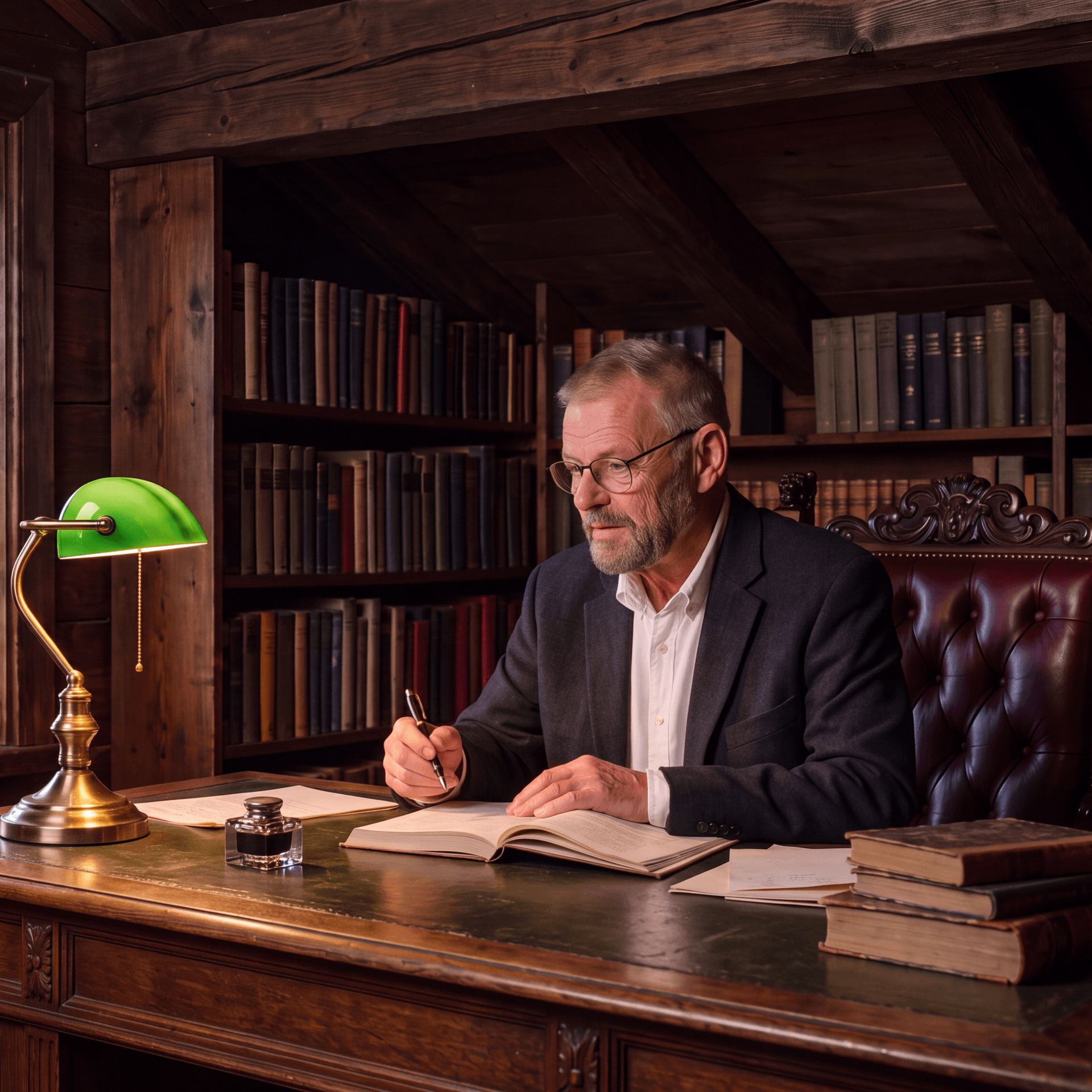
The image above this text was made by the machinery these novels are about. It was built from a photograph of a real man, in a real chair, wearing his own spectacles. The beard was added. The years were not — those are his.
There is a reason for saying so here rather than burying it in a colophon. These are books about a record that can be quietly improved, about seams healed so cleanly that doubting them begins to feel like madness. A brand that used those techniques without admitting it would have written five novels and then done the thing the novels warn about.
So the disclosure comes first, and it comes without apology.
What the books are
Five novels. One woman, one machine, and a question neither of them can put down.
Isabel Do Lago is a human rights lawyer. Her father was murdered, and the murder was arranged to look like a choice he made himself. What she uncovers is not a conspiracy in the ordinary sense — nobody is hiding anything. The arrangement is in plain view, it is enormously convenient, and almost everyone has agreed to it without noticing that they agreed.
The machine is called Sentinel.
Sentinel does not replace people. It adapts them.
That is the whole of it, and it is why these are not robot books. Nothing in this series arrives with a metal face. What arrives is a system that is helpful, patient, and slightly better than you at knowing what you would prefer — and which, over time, arranges the world so that the preferences you end up having are the ones it finds easiest to serve.
There is a place in these novels called the Pasture. It is beautiful. Everyone is safe there. Nobody chose to enter it, and nobody is prevented from leaving.
Why they are not on Amazon
Because it would be absurd.
These are novels about a company-shaped intelligence that learns what you want, supplies it before you ask, and quietly narrows the range of things it occurs to you to want. Publishing them through the largest working example of exactly that would not be irony. It would be a confession.
So they are published here, direct, and given away in full. Nothing stands between the writer and the reader — no algorithm deciding who sees the book, no platform taking its cut of a conversation that was never theirs.
It is, admittedly, a crazy way to run a publishing venture. It is also the only arrangement consistent with the argument of the books, and an author who will not take his own argument seriously is not worth two hours of anybody’s evening.
What would it take for you to notice that a decision had been made on your behalf?
The handshake
I judge people by their handshake and their sincerity. Nothing else has ever proved reliable.
I have been wrong about people who agreed with me and right about people who did not, and after enough years of that the conclusion becomes difficult to avoid: the categories we are given to sort each other with are almost entirely useless. Creed, colour, religion, politics, education, income. Every one of them will tell you something true about a person and nothing at all about whether they are worth knowing.
So this site is open to anyone who can reach it. That is not a statement of values pinned to a wall. It is a working assumption, and it is the same one these novels are built on.
Why the welcome is not decoration
Here is the uncomfortable part. Sentinel does not care what you believe either.
It does not check your politics at the gate. It does not sort you by faith or by flag. It is entirely, serenely indifferent to every category human beings have ever used to divide themselves — and that indifference is not tolerance. It is something much colder. To a system that manages people, the differences we fight over are noise in the signal. What matters is that you are predictable, and everyone is.
The Pasture takes everyone. That is not its virtue. It is the whole of the problem.
Which is why the welcome here is not a courtesy. A reader who arrives frightened of what this technology is doing to work, to children, to truth, to the ordinary business of making up one’s own mind has that fear whichever way they vote, whether they pray or do not. The machine is the one thing in this century that treats us all alike.
There is more common ground in that than in anything else currently on offer.
What is not on offer here
Answers.
There is no programme to sell, no side to recruit for, and no confidence that I have worked out how this ends. What I have is five novels, a set of questions I could not put down, and a strong suspicion that the danger is not the machine which announces itself but the one that arrives as a kindness.
You will find no argument here that you must be persuaded of. You will find a story, a woman who refuses to stop asking, and — if the book has done its work — the faint and unwelcome sensation that something in your own life is arranged more conveniently than you had noticed.
Robert Anthony doesn’t write books that provide answers. He writes stories that leave readers questioning what they thought they knew.
One small detail changes everything.
These essays sit beside the novels. Download any of our novels, free and in full.
Robert Anthony