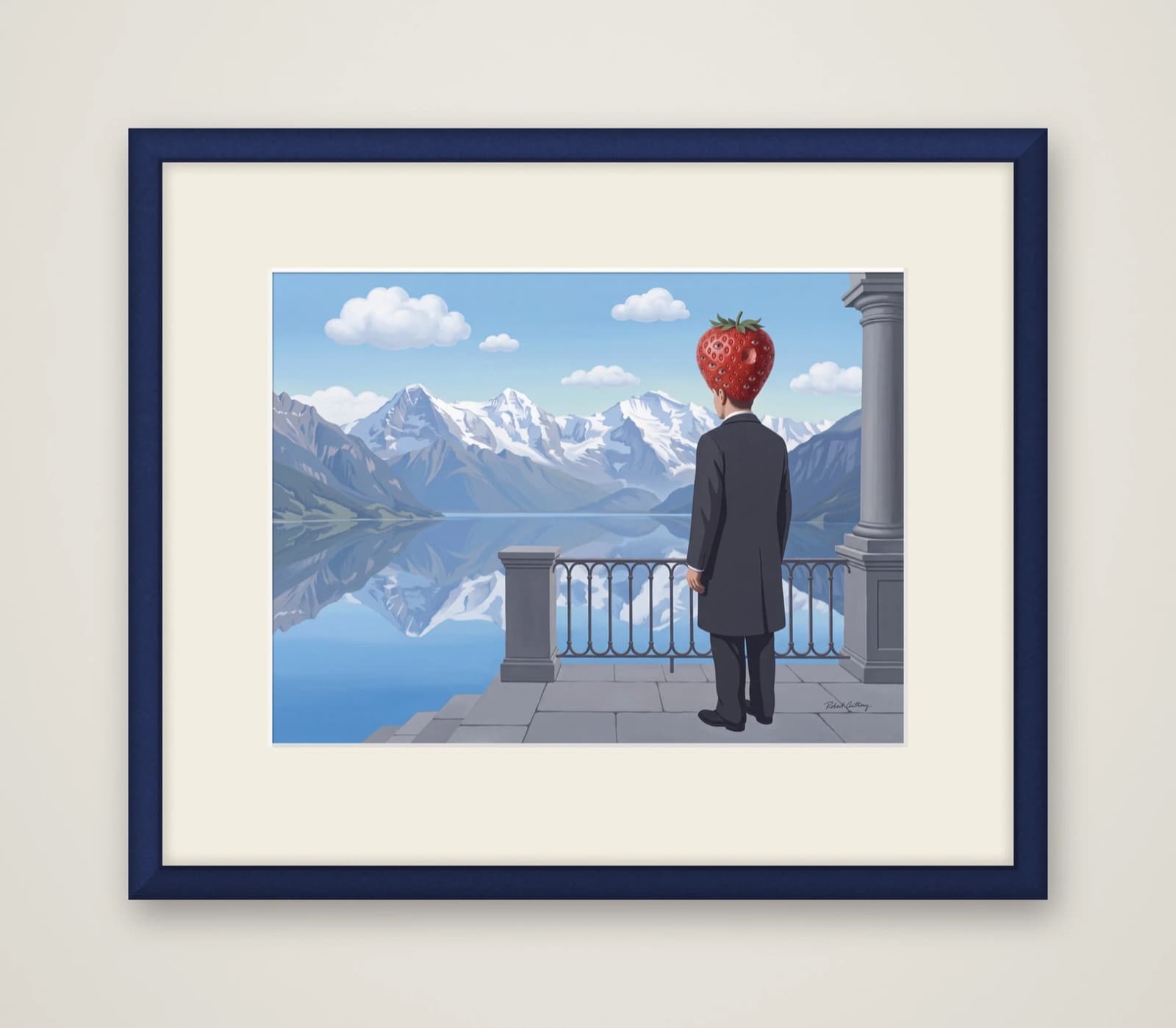
A tribute to René Magritte, 1898–1967
A young man in a dark coat stands at a stone balustrade, his back to us. In front of him a mountain lake lies so still that the snow peaks appear twice, once in the air and once in the water. We cannot see his face. Where it should be, there is a strawberry.
Nothing in the picture is strange on its own. A coat, a railing, a lake, a cloud, a piece of fruit. What is strange is where they have been put. That is the lesson of one quiet Belgian in a bowler hat, who spent forty years painting ordinary things in the wrong places until the whole world looked twice. This page is our thanks to him.
A boy from Hainaut
René Magritte was born on 21 November 1898 in Lessines, a small town in the French-speaking province of Hainaut, in Belgium. His father was a tailor and later a merchant, and the family moved from town to town. In 1912, when René was thirteen, his mother drowned herself in the river Sambre. He almost never spoke of it. People have looked for that loss in his later pictures ever since, and he always refused to explain them.
In 1913, at a fairground roundabout in Charleroi, he met a girl named Georgette Berger. They lost touch, met again by chance in Brussels in 1920, and married in 1922. She was his model, his first audience and his wife for the rest of his life.
Wallpaper and a picture that made him weep
He studied at the Académie Royale des Beaux-Arts in Brussels from 1916 to 1918, and found it dull. To earn a living he drew patterns in a wallpaper factory and designed posters and advertisements. That trade taught him something he never forgot: a picture must be clear, clean and instantly readable.
Then, in 1922, a poet friend showed him a reproduction of a painting by Giorgio de Chirico, a strange, silent street with a rubber glove and a classical head hung side by side. Magritte said it brought him to tears, and that his eyes had seen thought for the first time. From then on he wanted to paint not things, but the shock of things meeting where they should not.
Paris and the Surrealists
In 1926 a Brussels gallery gave him a contract, and he painted what he counted as his first true work, The Lost Jockey. His first solo exhibition, in Brussels in 1927, was badly received. Discouraged, he and Georgette moved to the edge of Paris, where he joined the Surrealists around the poet André Breton. For three years he painted at a furious pace, and in 1929 he produced the picture that made him famous: a pipe, beautifully painted, with the words Ceci n'est pas une pipe, "This is not a pipe", written beneath it. It isn't. It is a picture of a pipe. You cannot fill it with tobacco.
He never felt at home among the Paris Surrealists, who loved dreams, chaos and manifestos. In 1930 he went home to Brussels.
The man in the bowler hat
Magritte lived the rest of his life as the most ordinary-looking revolutionary in Europe. He wore a suit, a tie and a bowler hat. He painted in the dining room of a modest house, often in his good clothes, and never spilled a drop. He walked his dog, played chess and went back to commercial art with his brother Paul when money was short.
The Second World War tested him. During the German occupation of Belgium he stayed in Brussels and, in protest against the darkness, painted for a while in bright, sunny, almost cheerful colours. In 1948 he briefly did the opposite, a set of crude, loud pictures that shocked his Paris dealers. Then he returned to the calm, precise style the world now knows as his.
Fame came late. Only in the 1950s and 1960s, with big exhibitions in Europe and America, did he become one of the best-known painters of the century. He died in Brussels on 15 August 1967, aged 68. Georgette lived on in Brussels for nearly twenty years more.
Nine paintings to know
The Lovers (1928). Two lovers kiss, their heads wrapped in white cloth. Close, and yet they can never truly see each other.
The Treachery of Images (1929). The pipe that is not a pipe. Perhaps the most famous sentence ever written on a painting, and still the best lesson in the difference between a thing and its picture.
The Human Condition (1933). A painting on an easel stands in front of a window, showing exactly the view it hides. Where does the picture end and the world begin?
Not to Be Reproduced (1937). A man looks into a mirror and sees the back of his own head. The mirror refuses to give him his face.
Time Transfixed (1938). A steam locomotive rushes out of a fireplace in a quiet sitting room, smoke rising neatly into the chimney.
Personal Values (1952). A comb, a glass and a shaving brush, grown to the size of furniture, fill a bedroom whose walls are sky.
Golconda (1953). Men in overcoats and bowler hats hang in the air above a street like rain, or like stars, each one slightly different.
The Empire of Light (1954). A house at night under a streetlamp, beneath a bright daytime sky full of clouds. He painted many versions. One sold in New York in November 2024 for 121 million dollars, a record for his work.
The Son of Man (1964). A man in a bowler hat and overcoat, his face hidden by a floating green apple. It was a self-portrait, of a man who did not wish to be seen.
What the visible hides
Magritte disliked being asked what his pictures meant. They mean nothing, he said; they evoke mystery, and mystery cannot be explained. But he did once give a clue. Everything we see, he said, hides something else, and we always want to see what is hidden by what we see.
That is why so many of his faces are turned away, wrapped, or covered by an apple. It is why his windows show the view they block, and his mirrors refuse to reflect. He did not paint dreams. He painted the plain daylight world, then moved one thing, so that we would stop and look again.
Our canvas borrows his manners, the calm sky, the soft clouds, the figure seen from behind, the ordinary object where the face should be, and sets them beside a mountain lake that reflects everything except the one thing we want to know. Who is the young man? What is he looking at? We will never find out. Magritte would have approved.
Today the Magritte Museum in Brussels, opened in 2009 on the Place Royale, holds some two hundred of his works. If you are ever in Brussels, go and stand in front of them, and look twice.
Sources: René Magritte, Wikipedia · Brussels Times, 20 November 2024