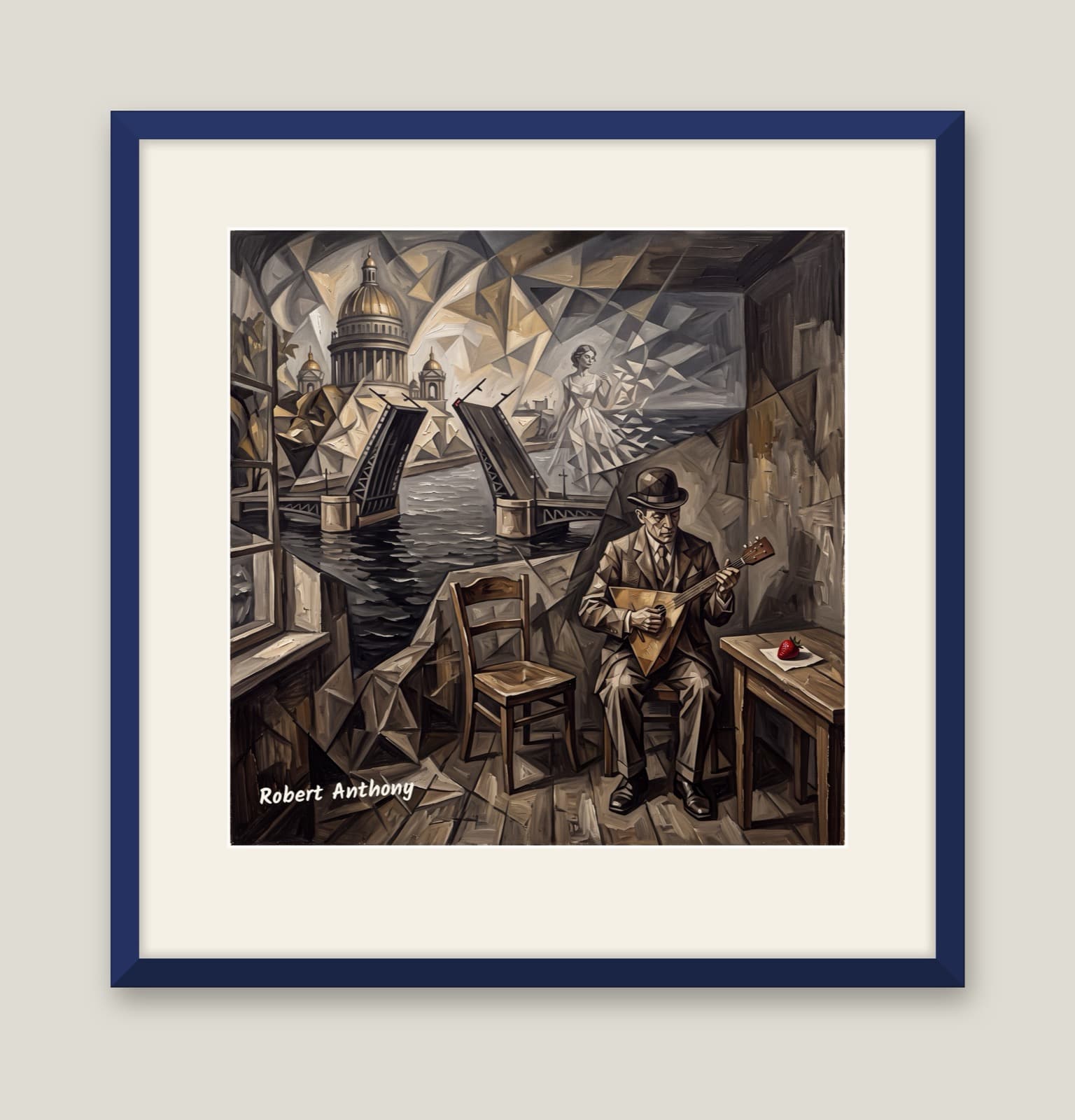
He bought one strawberry. The woman at the market stall looked at him as if he had made a mistake with the language, and held up the punnet, then two fingers, then the whole punnet again. He shook his head. One. She shrugged, picked the reddest from the top, and dropped it into his palm for nothing.
Arkady Volkov carried it up four flights to the rented room above the bay and set it on the little wooden table by the window. Then he sat down with the balalaika across his knees and did not play.
The room had a bed, a chair, a table and a second chair that nobody sat in. Below the window the water was grey and foreign and full of other men's boats. He had owned one of those boats once. It had been longer than this street. It had been painted the blue of a Petersburg sky in June, and it had a name he no longer said aloud, because the bank that held it now had given it a number instead.
They had taken the rest in the same polite way. The house with a hundred rooms. The tower with his name over the door. The paintings in the vault he had visited only twice, once to buy them and once to show a minister. Letters arrived in three languages, each saying that his accounts were frozen, each regretting the inconvenience. He had crossed the last border with a coat, a passport that worked in fewer countries every month, and a balalaika with three strings. It was the only thing he owned that nobody wanted.
The strawberry sat in the window light, so red it looked painted on.
She had been selling them at the gate of the Summer Garden. That was the first thing he had ever bought for love, though he had not known it at the time. A basket on her arm, a scarf slipping back from her hair, and cheeks so warm from the sun that he thought, she is the same colour as her strawberries. He told her so. She laughed at him and charged him double.
Her name was Katya. She was studying music and did not care for money, which he took at first for a joke and later for a reproach. In the white nights of that summer the sun barely set. It sank to the rim of the Gulf, hesitated, and climbed again. They walked the embankments without noticing the hours, because there was no darkness to tell them it was late.
One night they talked too long on the wrong bank of the Neva. At half past one the bridges began to rise. The great iron arms lifted slowly into the pale gold sky, and the river opened between them and the city. Every Petersburger knows this hour. If you are on the wrong side when the bridges rise, you stay there until morning.
They stayed. They sat on the granite steps with a paper bag of her strawberries between them, and she played him a song on a borrowed balalaika, badly, laughing at each wrong note. He remembered thinking that he would never need anything more than this. He remembered it precisely, because it was the last time he believed it.
The money came the way weather comes, all at once and from somewhere else. A contract, a licence, a friend of a friend in an office with tall windows. Within five years Arkady was building palaces of glass. Within ten he had forgotten how to walk anywhere.
Katya would not come into the glass. She said the rooms were too large to hear anyone in. She said he had started counting things that did not need counting. He bought her a necklace she never wore and a piano she never played, and one autumn evening she left both behind and took only the borrowed balalaika, which she had never given back.
He told himself she would return when she saw what he had become. She did not. He saw her once more, years later, from the back of a car. She was crossing the Summer Garden in the rain with a child by the hand, and she did not look up. The car did not stop. He had not told it to.
The balalaika on his knees now was not hers. He had bought it from a busker at a railway station on the night he left Russia, paying with the last notes in his wallet, because the sound of it on the platform had stopped him like a hand on his chest.
He tuned the three strings. He played the first notes of the song she had played on the steps, and found that his fingers knew it better than he did.
Somewhere, two thousand miles away, the bridges would be rising tonight. The iron arms would lift into the pale sky one after another, and the river would open, and young people would be stranded on the wrong bank and think themselves lucky.
He was on the wrong side too. Not of the river. Of the years.
He had traded the city for glass, and the girl for gold, and the gold had been taken back by men with stamps and polite letters. All that remained of the fortune was this: a rented room, one chair too many, and a strawberry the colour of a sun-kissed cheek, which he had not the heart to eat.
He played until the light went. Then he set the balalaika down beside the empty chair and said, to no one, in the language he now used only for prayers and apologies,
Прости, моя любовь.
Forgive me, my love.
The strawberry stayed where it was, on the table, in the dark, keeping its colour longer than seemed possible.