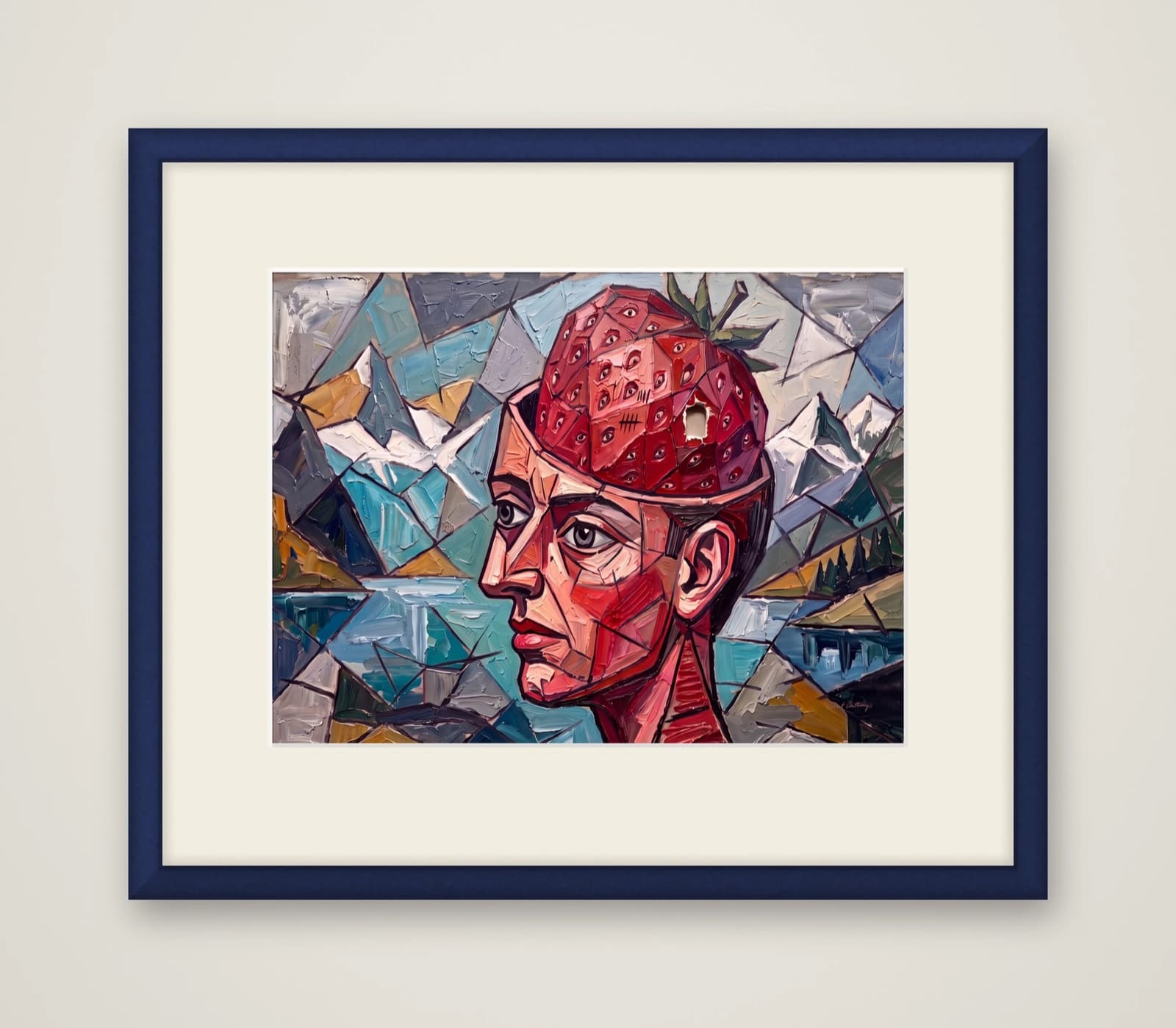
Anton Favre counted everything.
He counted the stones he cut, the francs he was paid for them, and the days between one payment and the next. He counted the steps from his door to his bench, and the boats that crossed Lac Léman in the window above it. He kept the totals on the wall behind the bench in pencil, in little fences of five: four upright strokes and a fifth laid across them like a gate. By the summer of 1962 the wall was grey with gates.
In June a man from Geneva brought him a ruby. It was the size of a wild strawberry and almost the same colour, rough as a pebble from the shore. The man wanted it cut in the old brilliant style. "Fifty-eight facets," he said. "Perfect. I am paying for perfect."
Anton worked on it for three weeks. He set it in its holder, bent to the wheel, and fixed his eye to the loupe until the mountains outside blurred into blue and white planes. One by one the facets came up out of the stone, each a small flat mirror holding a different piece of the room. He counted them aloud as he went.
Fifty-five. Fifty-six. Fifty-seven.
Then he stopped. Wherever he set the fifty-eighth, it fought the others. It threw the light the wrong way and muddied the red. He tried it at a dozen angles in his notebook and rubbed them all out. He sat in the evenings with the stone under the lamp, counting the facets again in case he had miscounted. There were fifty-seven. There were always fifty-seven.
That was the summer the band came to the hotel on the shore.
They were from Léopoldville, the Congo, independent for two years and dancing about it. The posters said Orchestre Rumba Lac and showed five men in pale suits. Every night from nine until past midnight their music came across the water and in at Anton's open window. Two guitars talked over each other in bright, looping lines. A bass walked underneath. Somewhere a man laughed into the microphone.
Anton tried to count it. He was a man who could count the teeth on a cog by ear, and he could not count this. The guitars came round and round like water on the shingle, never in the same place twice. Each time he caught the beat, it slipped out of his hand and turned up somewhere else. He lay awake with the ruby on the table beside him, its fifty-seven faces catching the lights from the terrace.
On the fifth night he put on his jacket and walked down to the hotel to complain.
The band was resting between sets. One of the guitarists sat on the terrace wall with his instrument across his knees and a bowl of strawberries beside him. He was tall, with a narrow moustache and a suit the colour of milky coffee. When Anton had finished explaining, politely, that the music was uncountable and kept decent people awake, the guitarist nodded as if this were a compliment.
"Mwamba," he said, holding out a hand. "And you are the man in the window with the lamp. Every night. Bent over something small."
Anton admitted that he was.
"You look at things from one side," said Mwamba. "Like a man at a keyhole. The music is not on one side. It is all round you. You have to stand in it."
He took a strawberry from the bowl and held it up between finger and thumb against the lights on the water.
"Look. Every seed is an eye. It sees you from everywhere at once. Now: you can count the seeds, or you can taste it. You cannot do both."
Anton, because he was Anton, began to count the seeds. He had reached thirty-one when Mwamba laughed, ate the strawberry, and went back inside to play.
He did not mean to go back. But on the last night of the season he found himself walking down to the shore again, and this time he went in.
The terrace was strung with paper lanterns. Couples turned slowly between the tables, and beyond the railing the lake was black and full of broken lights. Mwamba saw him and lifted his chin. A woman from the town, whom Anton had known by sight for twenty years and never spoken to, held out her hand. He took it because refusing would have been ruder.
At first his feet tried to count. Then the second guitar came in over the first, and something in him gave way.
He saw the whole evening at once. The lanterns, the water, the band, the woman's earrings, his own reflection breaking and mending in the dark glass of the hotel doors. He saw it not one piece after another but all together, from every side, like a face painted from the front and the profile in the same stroke. Like a stone turned so that every facet faced you at once. He forgot to count. When the music stopped, he could not have said how long he had danced, and he did not want to know.
In the morning the band's bus left along the lake road, and Anton went back to his bench.
The ruby sat in its holder with its fifty-seven facets. He looked at it for a long time without the loupe. Then he took up the stone and polished the place where the fifty-eighth should have been. He did not cut it flat. He left it soft and round, a small clear window in the side of the gem. When he held it to the light, the red no longer stopped at the surface. It moved. It went in at the window and came out of every face, warm and alive, the colour of a strawberry held up against the lights on the water.
The man from Geneva was furious. "Fifty-seven," he said. "I asked for perfect."
"It is," said Anton, and gave him back his money.
He kept the stone. That evening he took his pencil to the wall, where the last fence stood unfinished with four strokes. He drew the fifth across it, not as one more count but to close the gate. Then he went down to the market before it shut and bought a punnet of strawberries.
He never counted the seeds again. He found they tasted better that way.